


Page 2 - Open-Access-Oct-2020
P. 2
TECHNICAL PAPER


           surface of the wrap. Kim et al.  conducted an experimental   investigation. It is termed in-situ π-anchor and is inspired by the
                                  [14]
           study on reinforced concrete T-beams strengthened with   work of Mostafa and Razaqpur  [15] , who developed, fabricated,
           U-wraps, with and without spike anchors. One spike anchor was   and tested a π- anchor for preventing debonding of FRP
           passed at each end of the U-wrap and inserted into pre-drilled   laminates in beams strengthened in flexure. The difference
           holes in the concrete. It was found that the anchored U-wrap   between the proposed anchor and their anchor is in the stacking
           increased the beam strength 40% more than the unanchored   of the laminas in the anchor headplate and the placement of the
           U-wrap. Although spike anchors have been shown to be   laminate between the laminas of the headplate. Furthermore,
           effective, they involve penetration through the FRP wrap which   their anchor needs to be manufactured and cured prior to
           can cause damage to thinner wraps.                     installation while the proposed anchor can be made in-situ.

           Mechanical anchors consist of a steel or FRP plate bonded to
           the free ends of the FRP wrap. Steel bolts are then inserted   2.  EXPERIMENTAL PROGRAM
           through the plate and embedded into pre-drilled holes in
           the concrete. Bae and Belarbi  conducted an experimental   2.1  Test specimens
                                   [5]
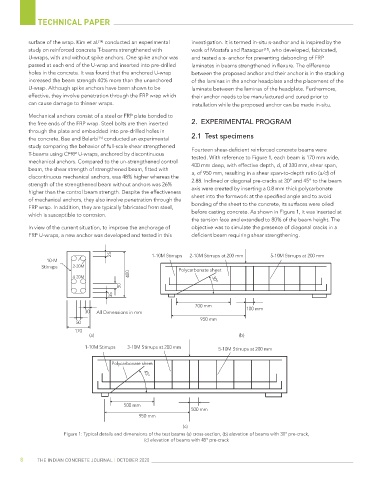
           study comparing the behavior of full-scale shear strengthened   Fourteen shear-deficient reinforced concrete beams were
           T-beams using CFRP U-wraps, anchored by discontinuous   tested. With reference to Figure 1, each beam is 170 mm wide,
           mechanical anchors. Compared to the un-strengthened control   400 mm deep, with effective depth, d, of 330 mm, shear span,
           beam, the shear strength of strengthened beam, fitted with   a, of 950 mm, resulting in a shear span-to-depth ratio (a/d) of
           discontinuous mechanical anchors, was 48% higher whereas the
           strength of the strengthened beam without anchors was 26%   2.88. Inclined or diagonal pre-cracks at 30° and 45° to the beam
           higher than the control beam strength. Despite the effectiveness   axis were created by inserting a 0.8 mm thick polycarbonate
           of mechanical anchors, they also involve penetration through the   sheet into the formwork at the specified angle and to avoid
           FRP wrap. In addition, they are typically fabricated from steel,   bonding of the sheet to the concrete, its surfaces were oiled
           which is susceptible to corrosion.                     before casting concrete. As shown in Figure 1, it was inserted at
                                                                  the tension face and extended to 80% of the beam height. The
           In view of the current situation, to improve the anchorage of   objective was to simulate the presence of diagonal cracks in a
           FRP U-wraps, a new anchor was developed and tested in this   deficient beam requiring shear strengthening.


                                      25            1-10M Stirrups  2-10M Stirrups at 200 mm  5-10M Stirrups at 200 mm
                 10-M
               Stirrups   2-20M                              Polycarbonate sheet
                                             400
                          4-20M                                          30°
                                          50
                                       35
                                                                   700 mm
                              30  All Dimensions in mm                              100 mm
                                                                     950 mm
                           50
                          170
                               (a)                                                ()
                                                                                  b
                              1-10M Stirrups  3-10M Stirrups at 200 mm
                                                                           5-10M Stirrups at 200 mm
                                       Polycarbonate sheet

                                                  45°


                                           500 mm
                                                                 500 mm
                                                950 mm
                                                               (c)
                       Figure 1: Typical details and dimensions of the test beams (a) cross-section, (b) elevation of beams with 30° pre-crack,
                                                  (c) elevation of beams with 45° pre-crack


        8     THE INDIAN CONCRETE JOURNAL | OCTOBER 2020

