


Page 6 - Open-Access-Oct-2020
P. 6
TECHNICAL PAPER


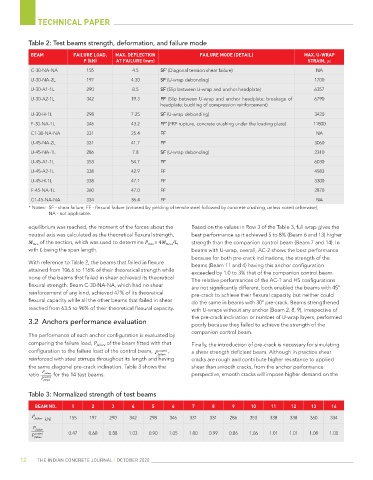
           Table 2: Test beams strength, deformation, and failure mode

           BEAM           FAILURE LOAD,    MAX. DEFLECTION          FAILURE MODE (DETAIL)               MAX. U-WRAP
                             P (kN)     AT FAILURE (mm)                                                  STRAIN, με
           C-30-NA-NA         155             4.5      SF (Diagonal tension shear failure)                  NA
                                                         *
           U-30-NA-2L         197            4.30      SF (U-wrap debonding)                               1700
           U-30-A1-1L         290             8.5      SF (Slip between U-wrap and anchor headplate)       6357
           U-30-A2-1L         342            19.3      FF (Slip between U-wrap and anchor headplate; breakage of   6790
                                                       headplate; buckling of compression reinforcement)
           U-30-H-1L          298            7.25      SF (U-wrap debonding)                               3420
           F-30-NA-1L         346            43.2      FF (FRP rupture, concrete crushing under the loading plate)  11800
                                                         *
           C1-30-NA-NA        331            25.4      FF                                                   NA
           U-45-NA-2L         331            41.7      FF                                                  3060
           U-45-NA-1L         286             7.8      SF (U-wrap debonding)                               2310
           U-45-A1-1L         353            54.7      FF                                                  6030
           U-45-A2-1L         338            42.9      FF                                                  4583
           U-45-H-1L          338            47.1      FF                                                  3300
           F-45-NA-1L         360            47.0      FF                                                  2870
           C1-45-NA-NA        334            36.4      FF                                                   NA
           * Notes:  SF - shear failure, FF - flexural failure (initiated by yielding of tensile steel followed by concrete crushing, unless noted otherwise),
                 NA - not applicable.

           equilibrium was reached, the moment of the forces about the   Based on the values in Row 3 of the Table 3, full wrap gives the
           neutral axis was calculated as the theoretical flexural strength,   best performance as it achieved 5 to 8% (Beam 6 and 13) higher
           M theo  of the section, which was used to determine P theo  = 4M theo  /L,   strength than the companion control beam (Beam 7 and 14). In
           with L being the span length.                          beams with U-wrap, overall, AC-2 shows the best performance
                                                                  because for both pre-crack inclinations, the strength of the
           With reference to Table 2, the beams that failed in flexure   beams (Beam 11 and 4) having this anchor configuration
           attained from 106.6 to 116% of their theoretical strength while   exceeded by 1.0 to 3% that of the companion control beam.
           none of the beams that failed in shear achieved its theoretical   The relative performances of the AC-1 and HS configurations
           flexural strength. Beam C-30-NA-NA, which had no shear   are not significantly different, both enabled the beams with 45°
           reinforcement of any kind, achieved 47% of its theoretical   pre-crack to achieve their flexural capacity, but neither could
           flexural capacity while all the other beams that failed in shear   do the same in beams with 30° pre-crack. Beams strengthened
           reached from 63.5 to 96% of their theoretical flexural capacity.  with U-wraps without any anchor (Beam 2, 8, 9), irrespective of
                                                                  the pre-crack inclination or number of U-wrap layers, performed
           3.2  Anchors performance evaluation                    poorly because they failed to achieve the strength of the
                                                                  companion control beam.
           The performance of each anchor configuration is evaluated by
           comparing the failure load, P failure  of the beam fitted with that   Finally, the introduction of pre-crack is necessary for simulating
                                                      control ,
           configuration to the failure load of the control beam,   P failure  a shear strength deficient beam. Although in practice shear
           reinforced with steel stirrups throughout its length and having   cracks are rough and contribute higher resistance to applied
           the same diagonal pre-crack inclination. Table 3 shows the    shear than smooth cracks, from the anchor performance
           ratio    for the 14 test beams.                        perspective, smooth cracks will impose higher demand on the


           Table 3: Normalized strength of test beams

             BEAM NO.    1      2      3     4      5      6      7      8     9      10    11     12     13     14
            P failure  kN   155  197  290    342   298    346    331    331    286   353    338    338    360   334


                        0.47   0.60   0.88  1.03   0.90   1.05   1.00   0.99  0.86   1.06   1.01   1.01  1.08   1.00


        12    THE INDIAN CONCRETE JOURNAL | OCTOBER 2020

