


Page 3 - Open-Access-Oct-2020
P. 3
TECHNICAL PAPER


           All the beams were identically reinforced in flexure with four 20M   200 mm
                              2
           steel bars (As = 1200 mm ) in tension and two 20M steel bars   FRP Wrap
           in compression. The internal shear reinforcement comprised
           10M (Ab = 100 mm ) stirrups with standard 90° hooks, spaced at                30°
                         2
           200 mm center to center, except for the stirrups near the beam
           ends. All strengthened beams had a 500 mm long segment
           devoid of steel stirrups in the diagonally pre-cracked region.
           Half the beams had a 30° diagonal crack and the other half a 45°   30 mm
           crack. The pre-cracked segment was later strengthened in shear   200 mm  700 mm
           with CFRP wraps.
                                                                           200 mm
                                                                   FRP Wrap
           2.2  Material properties
           The average compressive strength of the concrete obtained               45°
           from standard cyclinders was 48.5 MPa. Grade 400 steel was
           used for both shear and flexural internal reinforcement and was
           found, using ASTM A370  [16]  test method, to have an average
           yield strength of 420 MPa. A CFRP fabric was used as wrap      30 mm
           for shear strengthening and to make the anchor headplate.   200 mm  500 mm
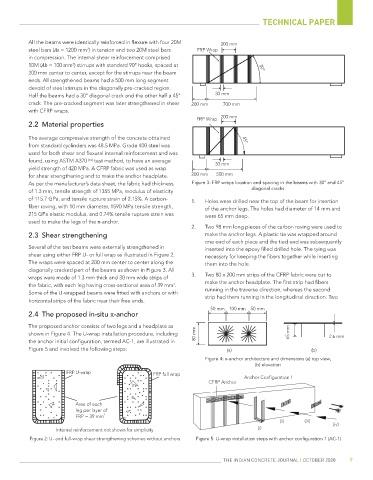
           As per the manufacturer’s data sheet, the fabric had thickness   Figure 3: FRP wraps location and spacing in the beams with 30° and 45°
                                                                                      diagonal cracks
           of 1.3 mm, tensile strength of 1355 MPa, modulus of elasticity
           of 115.7 GPa, and tensile rupture strain of 2.15%. A carbon-  1.   Holes were drilled near the top of the beam for insertion
           fiber roving, with 10 mm diameter, 1590 MPa tensile strength,   of the anchor legs. The holes had diameter of 14 mm and
           215 GPa elastic modulus, and 0.74% tensile rupture strain was   were 65 mm deep.
           used to make the legs of the π-anchor.
                                                                  2.   Two 98 mm long pieces of the carbon roving were used to
           2.3  Shear strengthening                                   make the anchor legs. A plastic tie was wrapped around
                                                                      one end of each piece and the tied end was subsequently
           Several of the test beams were externally strengthened in   inserted into the epoxy filled drilled hole. The tying was
           shear using either FRP U- or full wrap as illustrated in Figure 2.   necessary for keeping the fibers together while inserting
           The wraps were spaced at 200 mm center to center along the   them into the hole.
           diagonally cracked part of the beams as shown in Figure 3. All
           wraps were made of 1.3 mm thick and 30 mm wide strips of   3.   Two 80 x 200 mm strips of the CFRP fabric were cut to
           the fabric, with each leg having cross-sectional area of 39 mm .   make the anchor headplate. The first strip had fibers
                                                            2
           Some of the U-wrapped beams were fitted with anchors or with   running in the traverse direction, whereas the second
           horizontal strips of the fabric near their free ends.      strip had them running in the longitudinal direction. Two
                                                                        50 mm 100 mm  50 mm
           2.4  The proposed in-situ π-anchor
           The proposed anchor consists of two legs and a headplate as
           shown in Figure 4. The U-wrap installation procedure, including   80 mm                 65 mm        2.6 mm
           the anchor initial configuration, termed AC-1, are illustrated in
           Figure 5 and involved the following steps:                         (a)                         (b)
                                                                      Figure 4: π-anchor architecture and dimensions (a) top view,
                                                                                       (b) elevation
                       FRP U-wrap                    FRP full wrap
                                                                                   Anchor Configuration 1
                                                                       CFRP Anchor


                           Area of each
                           leg per layer of
                           FRP = 39 mm 2
                                                                                               (ii)     (iii)
                                                                                                                 (iv)
                    Internal reinforcement not shown for simplicity                     (i)
           Figure 2: U- and full-wrap shear strengthening schemes without anchors   Figure 5: U-wrap installation steps with anchor configuration 1 (AC-1)


                                                                            THE INDIAN CONCRETE JOURNAL | OCTOBER 2020  9

