


Page 5 - Open-Access-Oct-2020
P. 5
TECHNICAL PAPER


           numbers 30 and 45 in the designation refer to the diagonal pre-
           crack inclination while 1L and 2L denote U-wraps made of one
           and two layers of CFRP fabric, respectively.
           For convenience, in the ensuing discussion a beam may be
           referred to by its number or designation. It should be stated that
           the concrete surface in the U-wrapped region of beams, 8 and
           Beam 9 was sand blasted for improved bonding; in the other
           beams, the surface was cleaned by high pressure air.             (a)                         (b)
                                                                    Figure 8: Beam failure (a) Beam U-30-A1-1L, (b) Beam U-30-A2-1L
           The applied instrumentation included electrical resistance strain
           gauges for measuring the strain in the tensile reinforcement   inclinations to achieve their flexural capacity and fail in a ductile
           and in the wraps. Two strain gauges were placed on the tensile   manner.
           reinforcement at midspan and at the pre-cracked region. Six
           strain gauges were placed on the FRP wraps to measure their   Table 2 summarizes the failure load and mode, maximum
           strain in the vicinity of the shear crack. Three potentiometers   deflection, and the maximum U-wrap strain in each beam.
           were used to measure the beam deflection at mid and quarter   Flexural failure was ductile, initiated by steel yielding, while
           span. The beams were tested in three-point bending under   shear failure was brittle. In the strengthened beams, shear failure
           displacement control, and all the data was collected by an   was initiated by debonding of the U-wrap or by the anchor
           automatic data acquisition system.                     failure. All the beams that failed in flexure surpassed their
                                                                  theoretical failure load.
           3.  RESULTS AND DISCUSSION                             Since the beams had equal dimensions and longitudinal
                                                                  reinforcement, theoretically they have the same nominal flexural
           3.1  Observed failure modes and load-
                                                                  strength. Using strain compatibility analysis, experimentally
           deflection response
                                                                  measured f y  = 420 MPa and f  c    = 48.2 MPa, the theoretical flexural
                                                                                         '

           The failure modes were either shear or flexural. Failure was   failure load was calculated as P theo.  = 310.4 kN. To calculate
           initiated by diagonal tension, FRP debonding, slip between the   the latter load, (i) the cross-section at midspan was divided
           FRP U-wrap and the anchor headplate, breakage of the anchor   into 20 layers, made of concrete or steel, (ii) the strain was
           headplate, U-wrap rupture, tension steel yielding, followed by   assumed to vary linearly along the beam height, being zero at
           concrete crushing. Figure 8 shows typical failures of beams at   the neutral axis and 0.0035 at the extreme compression fiber,
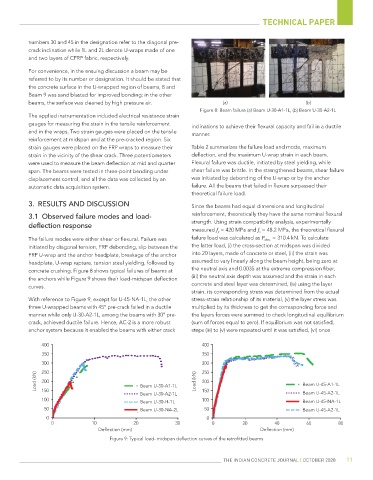
           the anchors while Figure 9 shows their load-midspan deflection   (iii) the neutral axis depth was assumed and the strain in each
           curves.                                                concrete and steel layer was determined, (iv) using the layer
                                                                  strain, its corresponding stress was determined from the actual
           With reference to Figure 9, except for U-45-NA-1L, the other   stress-strain relationship of its material, (v) the layer stress was
           three U-wrapped beams with 45° pre-crack failed in a ductile   multiplied by its thickness to get the corresponding force and
           manner while only U-30-A2-1L, among the beams with 30° pre-  the layers forces were summed to check longitudinal equilibrium
           crack, achieved ductile failure. Hence, AC-2 is a more robust   (sum of forces equal to zero). If equilibrium was not satisfied,
           anchor system because it enabled the beams with either crack   steps (iii) to (v) were repeated until it was satisfied, (vi) once

               400                                                   400
               350                                                   350
               300                                                   300
             N)  250                                               N)  250
             Load (k  200                       Beam U-30-A1-1L    Load (k  200                        Beam U-45-A1-1L

               150
                                                Beam U-30-A2-1L      150                               Beam U-45-A2-1L
               100                                                   100
                                                Beam U-30-H-1L                                         Beam U-45-NA-1L
                50                              Beam U-30-NA-2L       50                               Beam U-45-A2-1L
                 0                                                     0
                  0             10            20            30           0         20         40        60         80
                                  Deflection (mm)                                         Deflection (mm)
                                      Figure 9: Typical load- midspan deflection curves of the retrofitted beams


                                                                            THE INDIAN CONCRETE JOURNAL | OCTOBER 2020  11

