


Page 2 - Open-Access-Nov-2020
P. 2
TECHNICAL PAPER


           that reference (usually copper/copper sulphate or silver/silver      •   corrosion by chlorides assumes high degree of
           chloride electrodes).                                           saturation and then the values would be in the
                                                                           cathodic range and in general more stable providing
           The contact of the reference electrode and the concrete has to   the structure is submerged or permanently wet.
           be moist. Therefore, concrete of 1 to 2 mm should be saturated
           well in order to minimize the surface resistance. The saturation   Table 1 shows the values indicated in the Rilem
           is also provided by using a wet sponge between the probe and   Recommendation where some general comments are given for
           the concrete surface. The procedure explained should be taken   the possible (in some cases very wide) ranges. The difficulties
           into account in all electrochemical measurements in concrete.   in the interpretation of the E corr  values is also recognized in
           That is it also applies for the measurement of the electrical   the ASTM 879-14 standard by not giving any table for that
           resistance or of the corrosion rate.                   interpretation.

           2.1.1  Interpretation                                  In order to avoid the risk of misinterpretation of individual
                                                                  measurements, Rilem Recommendation and ASTM C876
           The corrosion potential indicates the “state” of corrosion of the   standard recommend not taking individual values but to
           bar, that is, whether the steel is corroding or not and whether   make “maps” from a regular grid size spaced 20 to 50 cm
           rebar has oxides on its surface. However, the values depend on  (see Figure 2), depending on the area to be measured and the
                                                                  reinforcement detailing. In the example of Figure 2, it has been
           (i)  temperature
                                                                  made 3 intervals of corrosion risk.
               •    it influences the degree of concrete saturation and
                    the types of steel oxides                     It is also recommended to plot the values measured in a
           (ii)   degree of water saturation of the concrete      structural element or area as a diagram of frequency distribution
                                                                  (Figure 3). For this, all values are grouped in intervals of potential
               •    the hydration degree of the oxides influences the
                    redox reaction between Fe  and Fe +3          and are plotted with respect to the number of readings in each
                                         +2
                                                                  group. In the example of Figure 3, all the potentials are in the
           (iii)   the resistivity
                                                                  level of low risk of corrosion and represent a unique family of
               •    the value is measured on the concrete surface. The   values.
                    values at the rebar surface are different due to the
                    concrete resistivity. The difference is higher as higher   A final warning on the risk of misinterpretation, if the E corr  is the
                    is the resistivity                            only parameter measured, is on its evolution with the external
           (iv)   carbonation or chlorides-induced corrosion      climatic conditions as is illustrated in Figure 4. The variation
                                                                  during summer and winter in south Europe are represented.
               •    carbonation means a lowering of the pH of the   The temperature varied in the Figure 4 from around 0 to 40ºC
                    concrete which introduces a shift of the potential
                    values towards more positive. The potential shift   Table 1: Ranges of potential with respect to the
                    follows Nernst law of being 60 mV more positive any   concrete and rebar condition  [1]
                    potential with a lowering of one unit of pH. Then,
                    the potential value would depend on the pH of the   TYPICAL RANGES OF POTENTIALS OF NORMAL STEEL IN CONCRETE
                                                                   (V vs CSE)
                    particular zone. In addition, the carbonation usually
                    is produced in partially saturated concrete with low   Water saturated concrete without oxygen  – 0.9 to – 1.0
                    degree of saturation.                          Wet, chloride contaminated concrete    – 0.4 to – 0.6
                                                                   Humid, chloride free concrete          + 0.1 to – 0.2
                                                                   Humid, carbonated concrete             + 0.1 to – 0.4
                                          mV
                                                                   Dry, carbonated or non-carbonated concrete  + 0.2 to 0


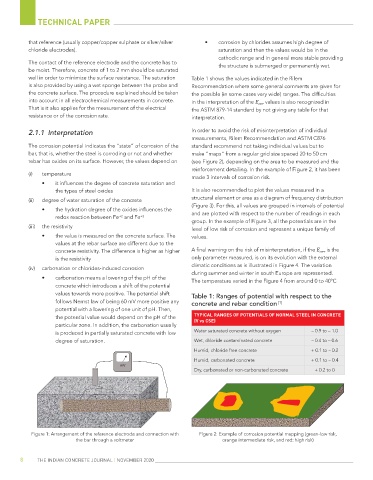
            Figure 1: Arrangement of the reference electrode and connection with   Figure 2: Example of corrosion potential mapping (green-low risk,
                           the bar through a voltmeter                      orange intermediate risk, and red: high risk)


        8     THE INDIAN CONCRETE JOURNAL | NOVEMBER 2020

