


Page 5 - Open-Access-Nov-2020
P. 5
TECHNICAL PAPER


           Table 4: Ranges of corrosion rate in concrete exposed to different condition
            CORROSION LEVEL  µA/cm 2    µm/Y         REBAR CONDITION                   CONCRETE CONDITION

              negligeable     < 0.1      < 1            Passive state     -  Non-carbonated without chlorides
                                                                          -  Very dry concrete carbonated or with chlorides
                 low         0.1 – 0.5  1 – 5     Depasivated in low humidity   -  with chlorides or carbonated at RH < 90%
                                                         concrete
               Moderate      0.5 – 1    5 – 10   Active corrosion in medium level   -  with chlorides or carbonated at RH > 90%
                                                         humidity

                 High          > 1      > 10      Large areas corroding in wet   -  saturated concrete heavily contaminated with chlorides
                                                         concrete

           systems. However, its application in real size elements is   2.3.2  Modulated confinement of the current
           not straight forward due to the need for the geometrical   (guard ring) method
           standardization of the area. A quasi-infinite area cannot be well
           polarized, because it will not be feasible to use the counter   This is the most efficient and simple way of accounting for a True
           electrode with the same area as that of the working area. Also,   R p  value, although electronically it is the most complex  . As
                                                                                                             [13]
           the estimation of R p  values from ∆E/∆I measurements in large   shown in Figure 10, there is a ring which surrounds the central
           structures is not feasible unless certain mathematical treatments   circular counter electrode, and it applies an independent
           are applied  [11,13] . This is because the counter electrode area is   electrical field in such a manner that the effect of central
           much smaller than the working area to be measured. In concrete   electrode is obliged to remain inside the ring. Hence, the ring is
           structures the electric signal is not concentrated just below the   named as ‘guard’ due to its effect of keeping the signal inside .
                                                                                                                    [8]
           small counter electrode, but its intensity decreases from the   The electronic operation is complex because, in order to confine
           border of the counter electrode until a distance (named the   the current to a particular rebar area, the guard ring has to
           critical length, L crit ) which depends on the square root of the   apply a counter current changed at each step throughout the
           ratio between the actual concrete ohmic resistance (moisture   polarization time. To control the guard ring in the “modulated”
           level) and the polarization resistance,                confinement method, two small reference electrodes are placed
                                                                  between the central counter and the guard ring called “ring
                                                        (9)
                                                                  controllers”. It is essential to have such “modulation” in order to
                    L crit  ~ √R e /R p
           Several methods can be used to overcome the problem of   avoid under - or over confinement of the current which ends in
           delimiting the area reached by the applied current. Here, two   wrong results.
           methods are commented:                                 The measurement has to be made by applying a pulse (more
           –   confining the current by means of a so named “guard   easily galvanostatic) lasting from 30 s (corroding) until 100 s
               ring”                                              (passive), from the central counter. Then, another counter
                                                                  current is applied from the external ring. As said, this external
           –   measuring and calculating the potential attenuation with   current is accounted by means of the reading of the voltage
               the distance
                                                                  drop between the two ring controllers, in order to achieve
                                                                  the required counterbalancing electrical field. The method
              10
                                                                  then makes an electrical delimitation of the area instead of
                                                                  determining it. Additionally, the equipment has to be able
            (µm)  1                                               to make automatically the removal (compensation) of the
            P corr                                                potential drop due to the concrete electrical resistance (IR) when
            (µA/cm )  and
                                                                  determining the the R p .
           2  0.1


            I corr  0.01

             0.001
                0.00   1.00  2.00  3.00  4.00  5.00  6.00  7.00
                                    Time (y)                                        Pcorr              Pcorr
                                   I corr    P corr
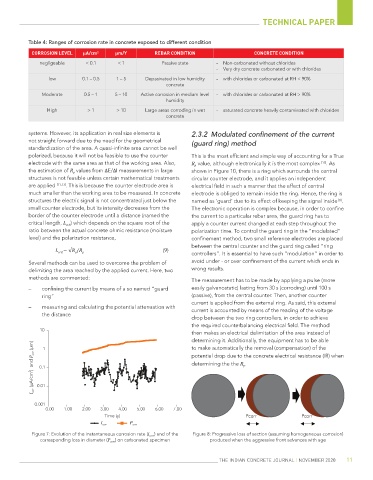
            Figure 7: Evolution of the instantaneous corrosion rate (I corr ) and of the   Figure 8: Progressive loss of section (assuming homogeneous corrosion)
              corresponding loss in diameter (P corr ) on carbonated specimen  produced when the aggressive front advances with age


                                                                           THE INDIAN CONCRETE JOURNAL | NOVEMBER 2020  11

