


Page 3 - Open-Access-Nov-2020
P. 3
TECHNICAL PAPER


                                  Bridge deck                     In laboratory it is easy to measure the resistivity of a specimen
             120
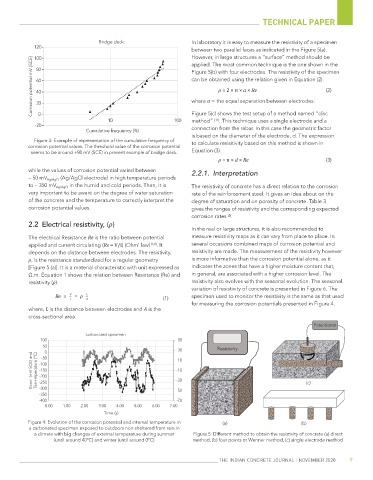
                                                                  between two parallel faces as indicated in the Figure 5(a).
                                                                  However, in large structures a “surface” method should be
            Corrosion potential mV (SCE)  80                      Figure 5(b) with four electrodes. The resistivity of the specimen
             100
                                                                  applied. The most common technique is the one shown in the
                                                                  can be obtained using the relation given in Equation (2).
             60
                                                                           ρ = 2 × π × a × Re
                                                                                                               (2)
             40
                                                                  where a = the equal separation between electrodes:
             20
              0
                                                                  method”  . This technique uses a single electrode and a
                                                                         [11]
                                     10                     100   Figure 5(c) shows the test setup of a method named “disc
             -20                                                  connection from the rebar. In this case the geometric factor
                              Cumulative frequency (%)
                                                                  is based on the diameter of the electrode, d. The expression
             Figure 3: Example of representation of the cumulative frequency of   to calculate resisitivity based on this method is shown in
          corrosion potential values. The threshold value of the corrosion potential
           seems to be around +80 mV (SCE) in present example of bridge deck.  Equation (3).
                                                                           ρ = π × d × Re                      (3)
           while the values of corrosion potential varied between    2.2.1.  Interpretation
           – 50 mV Ag/AgCl  (Ag/AgCl electrode) in high temperature periods
           to – 350 mV Ag/AgCl  in the humid and cold periods. Then, it is   The resistivity of concrete has a direct relation to the corrosion
           very important to be aware on the degree of water saturation   rate of the reinforcement steel. It gives an idea about on the
           of the concrete and the temperature to correctly interpret the   degree of saturation and on porosity of concrete. Table 3
           corrosion potential values.                            gives the ranges of resistivity and the corresponding expected
                                                                  corrosion rates  .
                                                                              [3]
           2.2  Electrical resistivity, (ρ)
                                                                  In the real or large structures, it is also recommended to
           The electrical Resistance Re is the ratio between potential   measure resistivity maps as it can vary from place to place. In
           applied and current circulating (Re = V/I) (Ohm’ law)  [3,8] . It   several occasions combined maps of corrosion potential and
           depends on the distance between electrodes. The resistivity,   resistivity are made. The measurement of the resistivity however
           ρ, is the resistance standardized for a regular geometry   is more informative than the corrosion potential alone, as it
           [Figure 5 (a)]. It is a material characteristic with unit expressed as   indicates the zones that have a higher moisture content that,
           Ω.m. Equation 1 shows the relation between Resistance (Re) and   in general, are associated with a higher corrosion level. The
           resistivity (ρ).                                       resistivity also evolves with the seasonal evolution. The seasonal
                                                                  variation of resistivity of concrete is presented in Figure 6. The
                                                        (1)       specimen used to monitor the resistivity is the same as that used
                                                                  for measuring the corrosion potentials presented in Figure 4.
           where, L is the distance between electrodes and A is the
           cross-sectional area.
                                                                                                           Potentiostat
                              carbonated specimen
               100                                           50
               50
                                                             30           Resistivity
                0                                            10
            Ecorr  (mV SCE) and  Ten+mperature (ºC)  -100   -10
               -50
              -150
              -200
                                                            -30
              -250
              -300
                                                            -50                                         (c)
              -350
              -400                                          -70
                0.00  1.00  2.00  3.00  4.00  5.00  6.00  7.00
                                    Time  (y)
          Figure 4: Evolution of the corrosion potential and internal temperature in   (a)             (b)
           a carbonated specimen exposed to outdoors non-sheltered from rain in
             a climate with big changes of external temperature during summer    Figure 5: Different method to obtain the resistivity of concrete (a) direct
                   (until around 40ºC) and winter (until around 0ºC)  method, (b) four points or Wenner method, (c) single electrode method


                                                                           THE INDIAN CONCRETE JOURNAL | NOVEMBER 2020  9

