


Page 17 - openaccess
P. 17
TECHNICAL PAPER


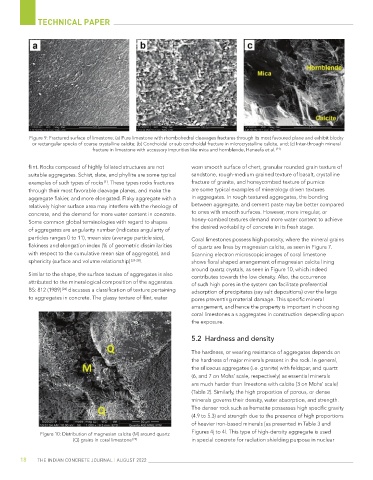
           Figure 9: Fractured surface of limestone; (a) Pure limestone with rhombohedral cleavages fractures through its most favoured plane and exhibit blocky
            or rectangular specks of coarse crystalline calcite; (b) Conchoidal or sub conchoidal fracture in microcrystalline calcite, and; (c) Inter-through mineral
                                fracture in limestone with accessory impurities like mica and hornblende, Haneefa et al.  [21]

           flint. Rocks composed of highly foliated structures are not   worn smooth surface of chert, granular rounded grain texture of
           suitable aggregates. Schist, slate, and phyllite are some typical   sandstone, rough-medium grained texture of basalt, crystalline
           examples of such types of rocks . These types rocks fractures   fracture of granite, and honeycombed texture of pumice
                                     [1]
           through their most favorable cleavage planes, and make the   are some typical examples of mineralogy driven textures
           aggregate flakier, and more elongated. Flaky aggregate with a   in aggregates. In rough textured aggregates, the bonding
           relatively higher surface area may interfere with the rheology of   between aggregate, and cement paste may be better compared
           concrete, and the demand for more water content in concrete.   to ones with smooth surfaces. However, more irregular, or
           Some common global terminologies with regard to shapes   honey-combed textures demand more water content to achieve
           of aggregates are angularity number (indicates angularity of   the desired workability of concrete in its fresh stage.
           particles ranges 0 to 11), mean size (average particle size),   Coral limestones possess high porosity, where the mineral grains
           flakiness and elongation index (% of geometric dissimilarities   of quartz are lines by magnesian calcite, as seen in Figure 7.
           with respect to the cumulative mean size of aggregate), and   Scanning electron microscopic images of coral limestone
           sphericity (surface and volume relationship)  [24-28] .   shows floral shaped arrangement of magnesian calcite lining
                                                                  around quartz crystals, as seen in Figure 10, which indeed
           Similar to the shape, the surface texture of aggregates is also   contributes towards the low density. Also, the occurrence
           attributed to the mineralogical composition of the aggerates.   of such high pores in the system can facilitate preferential
           BS: 812 (1989)  [24]  discusses a classification of texture pertaining   adsorption of precipitates (say salt depositions) over the large
           to aggregates in concrete. The glassy texture of flint, water   pores preventing material damage. This specific mineral
                                                                  arrangement, and hence the property is important in choosing
                                                                  coral limestones a s aggregates in construction depending upon
                                                                  the exposure.


                                                                  5.2  Hardness and density

                                                                  The hardness, or wearing resistance of aggregates depends on
                                                                  the hardness of major minerals present in the rock. In general,
                                                                  the siliceous aggregates (i.e. granite) with feldspar, and quartz
                                                                  (6, and 7 on Mohs’ scale, respectively) as essential minerals
                                                                  are much harder than limestone with calcite (3 on Mohs’ scale)
                                                                  (Table 2). Similarly, the high proportion of porous, or dense
                                                                  minerals governs their density, water absorption, and strength.
                                                                  The denser rock such as hematite possesses high specific gravity
                                                                  (4.9 to 5.3) and strength due to the presence of high proportions
                                                                  of heavier iron-based minerals [as presented in Table 3 and
               Figure 10: Distribution of magnesian calcite (M) around quartz    Figures 4j to 4l. This type of high-density aggregate is used
                          (Q) grains in coral limestone  [23]     in special concrete for radiation shielding purpose in nuclear


        18    THE INDIAN CONCRETE JOURNAL | AUGUST 2022

