


Page 20 - openaccess
P. 20
TECHNICAL PAPER


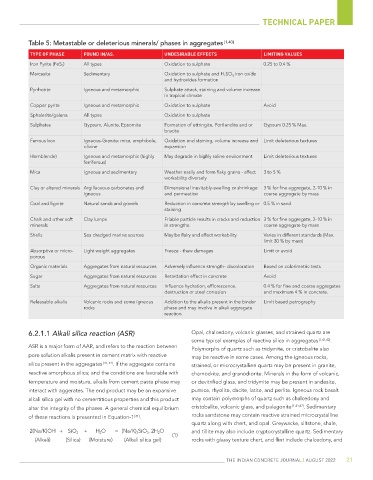
           Table 5: Metastable or deleterious minerals/ phases in aggregates  [1,40]

           TYPE OF PHASE     FOUND IN/AS.               UNDESIRABLE EFFECTS               LIMITING VALUES
           Iron Pyrite (FeS 2 )  All types              Oxidation to sulphate             0.25 to 0.4 %
           Marcasite         Sedimentary                Oxidation to sulphate and H 2 SO 4,  iron oxide
                                                        and hydroxides formation
           Pyrrhotite        Igneous and metamorphic    Sulphate attack, staining and volume increase
                                                        in tropical climate
           Copper pyrite     Igneous and metamorphic    Oxidation to sulphate             Avoid
           Sphalerite/galena  All types                 Oxidation to sulphate
           Sulphates         Gypsum, Alunite, Epsomite  Formation of ettringite, Portlandite and or   Gypsum 0.25 % Max.
                                                        brucite
           Ferrous Iron      Igneous-Granite: mica, amphibole,   Oxidation and staining, volume increase and  Limit deleterious textures
                             olivine                    expansion
           Hornblende)       Igneous and metamorphic (highly   May degrade in highly saline environment  Limit deleterious textures
                             ferriferous)
           Mica              Igneous and sedimentary    Weather easily and form flaky grains - affect   3 to 5 %
                                                        workability diversely
           Clay or altered minerals Argillaceous carbonates and   Dimensional inevitably-swelling or shrinkage   3 % for fine aggregate, 2-10 % in
                             igneous                    and permeation                    coarse aggregate by mass
           Coal and lignite   Natural sands and gravels  Reduction in concrete strength by swelling or  0.5 % in sand
                                                        staining
           Chalk and other soft   Clay lumps            Friable particle results in cracks and reduction  3 % for fine aggregate, 2-10 % in
           minerals                                     in strengths.                     coarse aggregate by mass
           Shells            Sea dredged marine sources   May be flaky and affect workability  Varies in different standards (Max.
                                                                                          limit 30 % by mass)
           Absorptive or micro-  Light weight aggregates   Freeze - thaw damages          Limit or avoid
           porous
           Organic materials  Aggregates from natural resources   Adversely influence strength- discoloration   Based on colorimetric tests
           Sugar             Aggregates from natural resources   Retardation effect in concrete  Avoid
           Salts             Aggregates from natural resources  Influence hydration, efflorescence,   0.4 % for fine and coarse aggregates
                                                        destruction or steel corrosion    and maximum 4 % in concrete.
           Releasable alkalis  Volcanic rocks and some igneous   Addition to the alkalis present in the binder   Limit based petrography.
                             rocks                      phase and may involve in alkali aggregate
                                                        reaction

           6.2.1.1 Alkali silica reaction (ASR)                   Opal, chalcedony, volcanic glasses, and strained quartz are
                                                                  some typical examples of reactive silica in aggregates  [1,41,42] .
           ASR is a major form of AAR, and refers to the reaction between
                                                                  Polymorphs of quartz such as tridymite, or cristobalite also
           pore solution alkalis present in cement matrix with reactive   may be reactive in some cases. Among the igneous rocks,
           silica present in the aggregates  [41, 42] . If the aggregate contains   strained, or microcrystalline quartz may be present in granite,
           reactive amorphous silica; and the conditions are favorable with   charnockite, and granodiorite. Minerals in the form of volcanic,
           temperature and moisture, alkalis from cement paste phase may   or devitrified glass, and tridymite may be present in andesite,
           interact with aggerates. The end product may be an expansive   pumice, rhyolite, dacite, latite, and perlite. Igneous rock basalt
           alkali silica gel with no cementitious properties and this product   may contain polymorphs of quartz such as chalcedony and
           alter the integrity of the phases. A general chemical equilibrium   cristobalite, volcanic glass, and palagonite  [1,41,42] . Sedimentary
           of these reactions is presented in Equation-1  [41] .   rocks sandstone may contain reactive strained microcrystalline
                                                                  quartz along with chert, and opal. Greywacke, siltstone, shale,
            2(Na/K)OH  +   SiO 2   +   H 2 O   =  (Na/K) 2 SiO 3 . 2H 2 O   and tillite may also include cryptocrystalline quartz. Sedimentary
                                                           (1)
             (Alkali)     (Silica)    (Moisture)     (Alkali silica gel)   rocks with glassy texture chert, and flint include chalcedony, and


                                                                             THE INDIAN CONCRETE JOURNAL | AUGUST 2022  21

