


Page 21 - openaccess
P. 21
TECHNICAL PAPER
opal along with cryptocrystalline quartz. Metamorphic rocks 6.2.1.3 A general discussion on testing of AAR
namely quartzite, schist, genies, hornfels, phyllite, and argillite
may comprise a reactive form of strained, microcrystalline to There are several test methods available to test the AAR in
cryptocrystalline quartz. In the case of calcareous rocks, calcitic, concrete. Those test methods can be categorized as initial [41]
dolostone, or dolomitic limestone may contain crypto crystalline screening test, rapid indicator test, and performance tests .
quartz, or opal as accessory impurity minerals [1,41,42] . The initial screening tests for aggregates include microanalytical
techniques such as thin section petrography, X-ray diffraction
(XRD), differential thermo gravimetric analysis (TG/DTA)
6.2.1.2 Alkali carbonate reaction (ACR) and gel past test [45-51] . Moreover, “The petrographic atlas:
Characterization of aggregates regarding potential reactivity to
ACR can be referred as the reaction between alkalis present [51]
in the binder phase with some susceptible carbonates present alkalis” (RILEM TC 219-ACS) is a standard text for reference.
This includes petrography pertaining to AAR related to igneous,
in the aggregates. This mechanism is reported in calcareous sedimentary and metamorphic rocks. The rapid indicator tests
aggregates such as argillaceous dolomitic limestone, and include the potential alkali reactivity of aggregates asper ASTM
dolomite with clay minerals present in them [1, 41-44] . A general C 289 [52] , mortar bar test asper ASTM C227 and accelerated
chemical equilibrium of these reactions is presented in mortar bar test asper ASTM C1260 [53] . Performances based tests
Equation-2 [39] .
include concrete prism method, modified prism method, ultra-
accelerated prism test and long-term structural monitoring [54-58] .
2(Na/K)OH + CaMg(CO 3 ) 2 CaCO 3 + Mg (OH) 2 + (Na/K) 2 CO 3
(2)
(Alkali) (Dolomite) (Calcite) (Brucite) (Alkali carbonate) A study by Mladenovic et al. [59] investigated ASR related to some
commonly used light weight aggregates. Along with perlite,
In ACR, there is no any formation of gel. It is an alkali hydroxide the study included expanded forms of vermiculite, clay, and
reaction, in which the dedolomitization of aggregate occurs due glass aggregates. Upon accelerated test as per ASTM C1260 [53] ,
to the reaction with alkalis. The end product will be brucite, and none of these aggregates was exhibiting any expansion due to
alkali carbonates. It is not a widespread mechanism, and normal ASR. However, the SEM images of perlite, and expanded glass
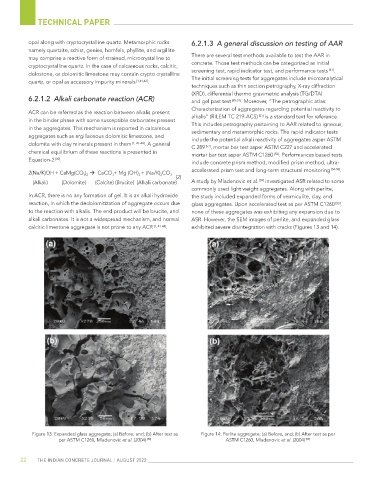
calcitic limestone aggregate is not prone to any ACR [1, 41-44] . exhibited severe disintegration with cracks (Figures 13 and 14).
Figure 13: Expanded glass aggregate; (a) Before, and; (b) After test as Figure 14: Perlite aggregate; (a) Before, and; (b) After test as per
per ASTM C1260, Mladenovic et al. (2004) [59] ASTM C1260, Mladenovic et al. (2004) [59]
22 THE INDIAN CONCRETE JOURNAL | AUGUST 2022

