


Page 18 - openaccess
P. 18
TECHNICAL PAPER


                                                                  unaltered or remaining phase is called as ‘resistate’ . Alkaline
                                                                                                           [9]
                                                                  elements possess high dissolution kinetics; whereas, resistate
                                                                  endures as sediment. Examples for some typical resistate
                                                                  are quartz, potash feldspar, and magnetite. Usually, the end
                                                                  products of chemical weathering are clay minerals. The basic
                                                                  clay minerals formed may be kaolinite, illite, and montmorillonite
                                                                         [9]
                                                                  (Table 3) . These hydrolysis reactions to form clay minerals are
                                                                  very complex . The hydrolysate cations present in the minerals
                                                                             [9]
                                                                  play a significant role in the sequential process of chemical
                                                                  weathering. In feldspar mineral, these ions may include K ,
                                                                                                               +
                                                                  Na , and Ca . In ferromagnesian mineral olivine, Mg  is the
                                                                           2+
                                                                                                            2+
                                                                    +
                                                                  susceptible hydrolysate cation. Pyroxene group minerals have
                                                                  Ca , and Mg  as hydrolysate cations. Amphibole group of
                                                                            2+
                                                                    2+
                                                                                            +
                                                                                                        2+
                                                                                                2+
                                                                  minerals are composed of K , Na , Ca , and Mg  with a great
                                                                                        +
              Figure 11: Physical appearance of vermiculite (Rashad, 2016)  [29]  affinity for hydrolysis reactions. The minerals with chemical
                                                                  weathering may exhibit a dull or drab appearance which
                                                                                                                   [9]
           power plants  [28] . Other igneous, sedimentary, or metamorphic   obscures the diagnostic properties during their identification .
                                                                                                               [9]
           rocks (may be siliceous, calcareous and silico-calcareous) with   The observations of Goldich (1938)  [31]  as cited by Perkins
           normal specific gravity ranges (2.5 to 3) are commonly used in   are relevant to aggregate chemical weathering. He found
           concrete as aggregates. There are exceptional cases of highly   that the minerals formed from molten magma at a relatively
           porous aggregates such as vermiculite shown in Figure 11  [29] .   high temperatures (deficient in Si, and O) are more prone to
           It is an altered product of biotite as a result of hydrothermal   chemical weathering compared to the minerals crystallized at
           phenomena. If vermiculite gets heated up to 650°C to 950°C, it   low temperatures. On the contrary, the ferromagnesian minerals
           expands continuously, and imparts a bulk density 10 to 11 less   of pyroxene or olivine groups, calcium rich feldspar, and other
           than the preheated density  [30] . The product can be used as   water-soluble minerals exhibited high weathering potentials. In
           aggregate to produce low density or light weight concrete. This   general, minerals with more Si-O bonds possess more resistant
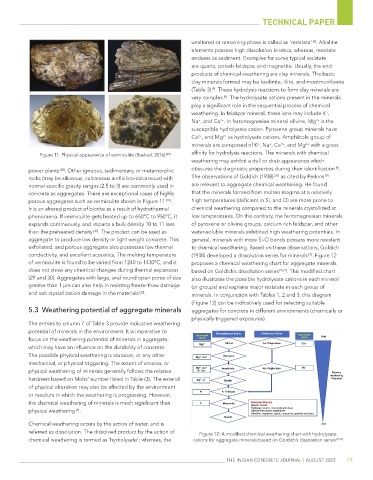
           exfoliated, and porous aggregate also possesses low thermal   to chemical weathering. Based on these observations, Goldich
           conductivity, and excellent acoustics. The melting temperature   (1938) developed a dissolution series for minerals . Figure 12
                                                                                                          [9]
           of vermiculite is found to be varied from 1240 to 1430°C, and it   proposes a chemical weathering chart for aggregate minerals
           does not show any chemical changes during thermal expansion   based on Goldich’s dissolution series  [9,31] . This modified chart
           (29 and 30). Aggregates with large, and round open pores of size   also illustrates the possible hydrolysate cations in each mineral
           greater than 1 µm can also help in resisting freeze-thaw damage   (or groups) and explains major resistate in each group of
           and salt crystallization damage in the materials  [23] .   minerals. In conjunction with Tables 1, 2 and 3, this diagram
                                                                  (Figure 12) can be indicatively used for selecting suitable
           5.3  Weathering potential of aggregate minerals        aggregates for concrete in different environments (chemically or
                                                                  physically triggered exposures).
           The entries to column 7 of Table 3 provide indicative weathering
           potential of minerals in the environment. It is imperative to
           focus on the weathering potential of minerals in aggregate,
           which may have an influence on the durability of concrete.
           The possible physical weathering is abrasion, or any other
           mechanical, or physical triggering. The extent of erosion, or
           physical weathering of minerals generally follows the relative
           hardness based on Mohs’ number listed in Table (3). The extend
           of physical alteration may also be affected by the environment
           or medium in which the weathering is progressing. However,
           the chemical weathering of minerals is much significant than
           physical weathering .
                           [9]
           Chemical weathering occurs by the action of water, and is
           referred as dissolution. The dissolved product by the action of   Figure 12: A modified chemical weathering chart with hydrolysate
           chemical weathering is termed as ‘hydrolysate’; whereas, the   cations for aggregate minerals based on Goldich’s dissolution series  [9,31]


                                                                             THE INDIAN CONCRETE JOURNAL | AUGUST 2022  19

