


Page 23 - openaccess
P. 23
TECHNICAL PAPER


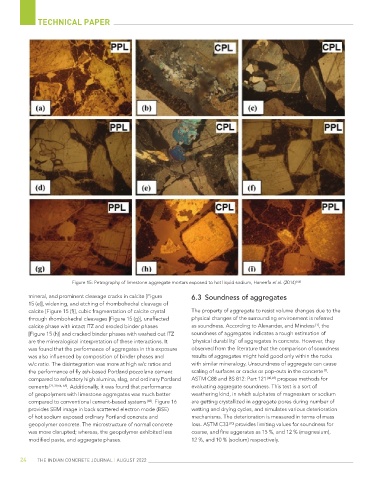
                         Figure 15: Petrography of limestone aggregate mortars exposed to hot liquid sodium, Haneefa el al. (2014)  [64]

           mineral, and prominent cleavage cracks in calcite [Figure   6.3  Soundness of aggregates
           15 (e)], widening, and etching of rhombohedral cleavage of
           calcite [Figure 15 (f)], cubic fragmentation of calcite crystal   The property of aggregate to resist volume changes due to the
           through rhombohedral cleavages [Figure 15 (g)], unaffected   physical changes of the surrounding environment is referred
                                                                                                            [1]
           calcite phase with intact ITZ and eroded binder phases   as soundness. According to Alexander, and Mindess , the
           [Figure 15 (h)] and cracked binder phases with washed out ITZ   soundness of aggregates indicates a rough estimation of
           are the mineralogical interpretation of these interactions. It   ‘physical durability’ of aggregates in concrete. However, they
           was found that the performance of aggregates in this exposure   observed from the literature that the comparison of soundness
           was also influenced by composition of binder phases and   results of aggregates might hold good only within the rocks
           w/c ratio. The disintegration was more at high w/c ratios and   with similar mineralogy. Unsoundness of aggregate can cause
                                                                                                               [1]
           the performance of fly ash-based Portland pozzolana cement   scaling of surfaces or cracks or pop-outs in the concrete .
           compared to refractory high alumina, slag, and ordinary Portland   ASTM C88 and BS 812: Part 121  [40,69]  propose methods for
           cements  [21,39,64, 68] . Additionally, it was found that performance   evaluating aggregate soundness. This test is a sort of
           of geopolymers with limestone aggregates was much better   weathering kind, in which sulphates of magnesium or sodium
           compared to conventional cement-based systems  [68] . Figure 16   are getting crystallized in aggregate pores during number of
           provides SEM image in back scattered electron mode (BSE)   wetting and drying cycles, and simulates various deterioration
           of hot sodium exposed ordinary Portland concrete and   mechanisms. The deterioration is measured in terms of mass
           geopolymer concrete. The microstructure of normal concrete   loss. ASTM C33  [70]  provides limiting values for soundness for
           was more disrupted; whereas, the geopolymer exhibited less   coarse, and fine aggerates as 15 %, and 12 % (magnesium),
           modified paste, and aggregate phases.                  12 %, and 10 % (sodium) respectively.


        24    THE INDIAN CONCRETE JOURNAL | AUGUST 2022

