


Page 27 - openaccess
P. 27
TECHNICAL PAPER


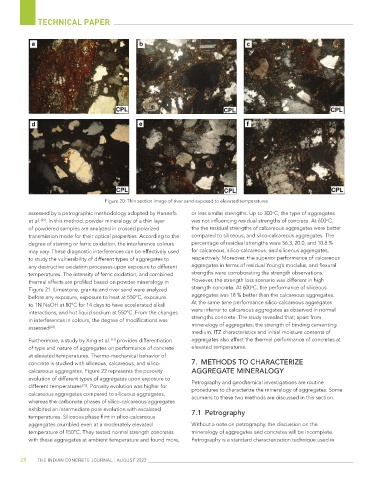
                                    Figure 20: Thin section image of river sand exposed to elevated temperatures
           assessed by a petrographic methodology adopted by Haneefa   or less similar strengths. Up to 300 C, the type of aggregates
                                                                                             o
                                                                                                               o
           et al.  [21] . In this method, powder mineralogy of a thin layer   was not influencing residual strengths of concrete. At 600 C,
           of powdered samples are analyzed in crossed polarized   the the residual strengths of calcareous aggregates were better
           transmission mode for their optical properties. According to the   compared to siliceous, and silco-calcareous aggregates. The
           degree of staining or ferric oxidation, the interference colours   percentage of residual strengths were 56.3, 20.0, and 10.8 %
           may vary. These diagnostic interferences can be effectively used   for calcareous, silico-calcareous, and siliceous aggregates,
           to study the vulnerability of different types of aggregates to   respectively. Moreover, the superior performance of calcareous
           any destructive oxidation processes upon exposure to different   aggregates in terms of residual Young’s modulus, and flexural
           temperatures. The intensity of ferric oxidation, and combined   strengths were corroborating the strength observations.
           thermal effects are profiled based on powder mineralogy in   However, the strength loss scenario was different in high
                                                                                      o
           Figure 21. Limestone, granite and river sand were analyzed   strength concrete. At 600 C, the performance of siliceous
           before any exposure, exposure to heat at 550°C, exposure   aggregates was 18 % better than the calcareous aggregates.
           to 1N NaOH at 80°C for 14 days to have accelerated alkali   At the same time performance silico-calcareous aggregates
           interactions, and hot liquid sodium at 550°C. From the changes   were inferior to calcareous aggregates as observed in normal
           in interferences in colours, the degree of modifications was   strengths concrete. The study revealed that; apart from
           assessed  [21] .                                       mineralogy of aggregates; the strength of binding cementing
                                                                  medium, ITZ characteristics and initial moisture contents of
           Furthermore, a study by Xing et al.  [73]  provides differentiation   aggregates also affect the thermal performance of concretes at
           of type and nature of aggregates on performance of concrete   elevated temperatures.
           at elevated temperatures. Thermo-mechanical behavior of
           concrete is studied with siliceous, calcareous, and silico-  7.  METHODS TO CHARACTERIZE
           calcareous aggregates. Figure 22 represents the porosity   AGGREGATE MINERALOGY
           evolution of different types of aggregates upon exposure to
           different temperatures  [73] . Porosity evolution was higher for   Petrography and geochemical investigations are routine
                                                                  procedures to characterize the mineralogy of aggregates. Some
           calcareous aggregates compared to siliceous aggregates,   acumens to these two methods are discussed in this section.
           whereas the carbonate phases of silico-calcareous aggregates
           exhibited an intermediate pore evolution with escalated   7.1  Petrography
           temperatures. Siliceous phase flint in silico-calcareous
           aggregates crumbled even at a moderately elevated      Without a note on petrography, the discussion on the
           temperature of 150°C. They tested normal strength concretes   mineralogy of aggregates and concretes will be incomplete.
           with these aggregates at ambient temperature and found more,   Petrography is a standard characterization technique used in


        28    THE INDIAN CONCRETE JOURNAL | AUGUST 2022

