


Page 24 - openaccess
P. 24
TECHNICAL PAPER


                              Figure 16: SEM-BSE image of (a) OPC concrete; and (b) Geopolymer; with limestone aggregate
                                          after exposure to hot liquid sodium, Haneefa et al. (2013)  [64, 68]

           6.4  Thermal properties of concrete                    (a)

           Concrete consists of different phases exhibiting different
           thermal characteristics. Thermal properties of concrete making
           materials vary widely based on their mineralogy  [1,21,63,64] .
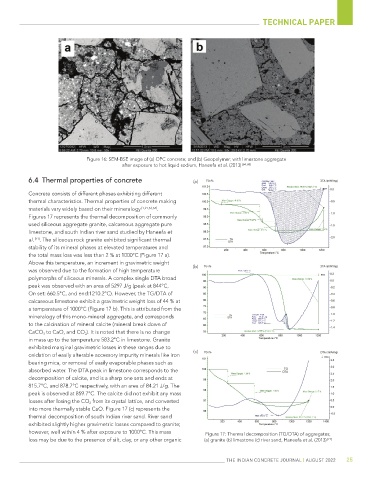
           Figures 17 represents the thermal decomposition of commonly
           used siliceous aggregate granite, calcareous aggregate pure
           limestone, and south Indian river sand studied by Haneefa et
           al.  [21] . The siliceous rock granite exhibited significant thermal
           stability of its mineral phases at elevated temperatures and
           the total mass loss was less than 2 % at 1000°C (Figure 17 a).
           Above this temperature, an increment in gravimetric weight
           was observed due to the formation of high temperature   (b)
           polymorphs of siliceous minerals. A complex single DTA broad
           peak was observed with an area of 5297 J/g (peak at 844°C,
           On set: 660.5°C, and end:1210.2°C). However, the TG/DTA of
           calcareous limestone exhibit a gravimetric weight loss of 44 % at
           a temperature of 1000°C (Figure 17 b). This is attributed from the
           mineralogy of this mono-mineral aggregate, and corresponds
           to the calcination of mineral calcite (mineral break down of
           CaCO 3  to CaO, and CO 2 ). It is noted that there is no change
           in mass up to the temperature 583.2°C in limestone. Granite
           exhibited marginal gravimetric losses in these ranges due to
           oxidation of easily alterable accessory impurity minerals like iron   (c)
           bearing mica, or removal of easily evaporable phases such as
           absorbed water. The DTA peak in limestone corresponds to the
           decomposition of calcite, and is a sharp one sets and ends at
           815.7°C, and 878.7°C respectively, with an area of 84.21 J/g. The
           peak is observed at 859.7°C. The calcite did not exhibit any mass
           losses after losing the CO 2  from its crystal lattice, and converted
           into more thermally stable CaO. Figure 17 (c) represents the
           thermal decomposition of south Indian river sand. River sand
           exhibited slightly higher gravimetric losses compared to granite;
           however, well within 4 % after exposure to 1000°C. This mass   Figure 17: Thermal decomposition (TG/DTA) of aggregates;
           loss may be due to the presence of silt, clay, or any other organic   (a) granite (b) limestone (c) river sand, Haneefa et al. (2013)  [21]


                                                                             THE INDIAN CONCRETE JOURNAL | AUGUST 2022  25

