


Page 26 - openaccess
P. 26
TECHNICAL PAPER


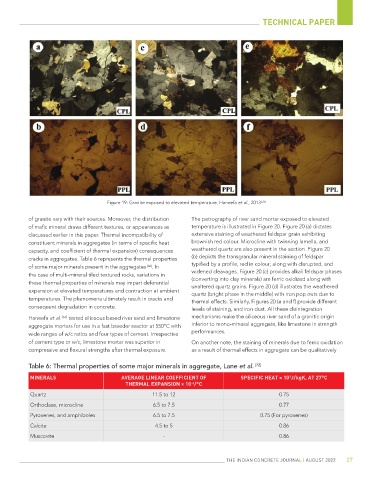
                                     Figure 19: Granite exposed to elevated temperature, Haneefa et al., 2013  [21]

           of granite vary with their sources. Moreover, the distribution   The petrography of river sand mortar exposed to elevated
           of mafic mineral draws different textures, or appearances as   temperature is illustrated in Figure 20. Figure 20 (a) dictates
           discussed earlier in this paper. Thermal incompatibility of   extensive staining of weathered feldspar grain exhibiting
           constituent minerals in aggregates (in terms of specific heat   brownish red colour. Microcline with twinning lamella, and
           capacity, and coefficient of thermal expansion) consequences   weathered quartz are also present in the section. Figure 20
           cracks in aggregates. Table 6 represents the thermal properties   (b) depicts the transgranular mineral staining of feldspar
           of some major minerals present in the aggregates  [66] . In   typified by a profile, red in colour; along with disrupted, and
           the case of multi-mineral tiled textured rocks, variations in   widened cleavages. Figure 20 (c) provides alkali feldspar phases
           these thermal properties of minerals may impart deferential   (converting into clay minerals) are ferric oxidized along with
                                                                  unaltered quartz grains. Figure 20 (d) illustrates the weathered
           expansion at elevated temperatures and contraction at ambient   quartz (bright phase in the middle) with iron pop outs due to
           temperatures. The phenomena ultimately result in cracks and   thermal effects. Similarly, Figures 20 (e and f) provide different
           consequent degradation in concrete.                    levels of staining, and iron dust. All these disintegration
           Haneefa et al.  [63]  tested siliceous based river sand and limestone   mechanisms make the siliceous river sand of a granitic origin
           aggregate mortars for use in a fast breeder reactor at 550°C with   inferior to mono-mineral aggregate, like limestone in strength
           wide ranges of w/c ratios and four types of cement. Irrespective   performances.
           of cement type or w/c, limestone mortar was superior in   On another note, the staining of minerals due to ferric oxidation
           compressive and flexural strengths after thermal exposure.   as a result of thermal effects in aggregate can be qualitatively

           Table 6: Thermal properties of some major minerals in aggregate, Lane et al.  [72]

           MINERALS                       AVERAGE LINEAR COEFFICIENT OF           SPECIFIC HEAT × 10 J/kgK, AT 27°C
                                                                                                   3
                                           THERMAL EXPANSION × 10 /°C
                                                                 -6
           Quartz                                   11.5 to 12                                 0.75
           Orthoclase, microcline                    6.5 to 7.5                                0.77
           Pyroxenes, and amphiboles                 6.5 to 7.5                          0.75 (For pyroxenes)
           Calcite                                   4.5 to 5                                  0.86
           Muscovite                                    -                                      0.86


                                                                             THE INDIAN CONCRETE JOURNAL | AUGUST 2022  27

