


Page 25 - openaccess
P. 25
TECHNICAL PAPER


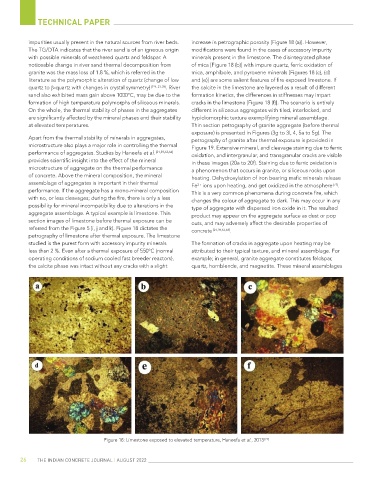
           impurities usually present in the natural sources from river beds.   increase in petrographic porosity [Figure 18 (a)]. However,
           The TG/DTA indicates that the river sand is of an igneous origin   modifications were found in the cases of accessory impurity
           with possible minerals of weathered quartz and feldspar. A   minerals present in the limestone. The disintegrated phase
           noticeable change in river sand thermal decomposition from   of mica [Figure 18 (b)] with impure quartz, ferric oxidation of
           granite was the mass loss of 1.8 %, which is referred in the   mica, amphibole, and pyroxene minerals [Figures 18 (c), (d)
           literature as the polymorphic alteration of quartz (change of low   and (e)] are some salient features of fire exposed limestone. If
           quartz to β-quartz with changes in crystal symmetry)  [7-9, 21,39] . River   the calcite in the limestone are layered as a result of different
           sand also exhibited mass gain above 1000°C, may be due to the   formation kinetics, the differences in stiffnesses may impart
           formation of high temperature polymorphs of siliceous minerals.   cracks in the limestone [Figure 18 (f)]. The scenario is entirely
           On the whole, the thermal stability of phases in the aggregates   different in siliceous aggregates with tiled, interlocked, and
           are significantly affected by the mineral phases and their stability   hypidiomorphic texture exemplifying mineral assemblage.
           at elevated temperatures.                              Thin section petrography of granite aggregate (before thermal
                                                                  exposure) is presented in Figures (3g to 3l, 4, 5a to 5g). The
           Apart from the thermal stability of minerals in aggregates,   petrography of granite after thermal exposure is provided in
           microstructure also plays a major role in controlling the thermal   Figure 19. Extensive mineral, and cleavage staining due to ferric
           performance of aggregates. Studies by Haneefa et al.  [21,39,63,64]    oxidation, and intergranular, and transgranular cracks are visible
           provides scientific insight into the effect of the mineral   in these images (20a to 20f). Staining due to ferric oxidation is
           microstructure of aggregate on the thermal performance   a phenomenon that occurs in granite, or siliceous rocks upon
           of concrete. Above the mineral composition, the mineral   heating. Dehydroxylation of iron bearing mafic minerals release
           assemblage of aggregates is important in their thermal   Fe  ions upon heating, and get oxidized in the atmosphere  [71] .
                                                                    2+
           performance. If the aggregate has a mono-mineral composition   This is a very common phenomena during concrete fire, which
           with no, or less cleavages; during the fire, there is only a less   changes the colour of aggregate to dark. This may occur in any
           possibility for mineral incompatibility due to alterations in the   type of aggregate with dispersed iron oxide in it. The resulted
           aggregate assemblage. A typical example is limestone. Thin   product may appear on the aggregate surface as dust or pop
           section images of limestone before thermal exposure can be   outs, and may adversely affect the desirable properties of
           referred from the Figure 5 [i, j and k). Figure 18 dictates the   concrete  [21,39,63,64] .
           petrography of limestone after thermal exposure. The limestone
           studied is the purest form with accessory impurity minerals   The formation of cracks in aggregate upon heating may be
           less than 2 %. Even after a thermal exposure of 550°C (normal   attributed to their typical texture, and mineral assemblage. For
           operating conditions of sodium cooled fast breeder reactors),   example; in general, granite aggregate constitutes feldspar,
           the calcite phase was intact without any cracks with a slight   quartz, hornblende, and magnetite. These mineral assemblages


                                    Figure 18: Limestone exposed to elevated temperature, Haneefa et al., 2013  [21]


        26    THE INDIAN CONCRETE JOURNAL | AUGUST 2022

