


Page 33 - ICJ Jan 2026
P. 33
TECHNICAL PAPER


                                Cement type
                                                      PPC
             14                                       PSC
                                                      OPC
                                                      PPC
             12                                       PSC
                                                      OPC
             10                            y(PPC) = 10.149x + 2.0706
             Icorr (µA/cm 2 )  8 6         y(PSC) = 14.425x + 2.3361
                                                      R = 0.986

                                                     R = 0.959
              4
                                            y(OPC) = 20.884x + 2.177
              2                                       R = 0.942
              0
                0    0.1   0.2   0.3   0.4   0.5
                     Free chloride concentration (%)

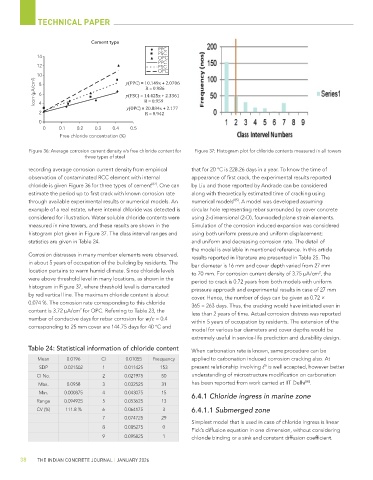
           Figure 36: Average corrosion current density v/s free chloride content for   Figure 37: Histogram plot for chloride contents measured in all towers
                              three types of steel

           recording average corrosion current density from empirical   that for 20 °C is 228.26 days in a year. To know the time of
           observation of contaminated RCC element with internal   appearance of first crack, the experimental results reported
                                                    [82]
           chloride is given Figure 36 for three types of cement . One can   by Liu and those reported by Andrade can be considered
           estimate the period up to first crack with known corrosion rate   along with theoretically estimated time of cracking using
                                                                                [85]
           through available experimental results or numerical models. An   numerical models . A model was developed assuming
           example of a real estate, where internal chloride was detected is   circular hole representing rebar surrounded by cover concrete
           considered for illustration. Water soluble chloride contents were   using 2-dimensional (2-D), four-noded plane strain elements.
           measured in nine towers, and these results are shown in the   Simulation of the corrosion induced expansion was considered
           histogram plot given in Figure 37. The class interval ranges and   using both uniform pressure and uniform displacement;
           statistics are given in Table 24.                      and uniform and decreasing corrosion rate. The detail of
                                                                  the model is available in mentioned reference. In this article
           Corrosion distresses in many member elements were observed,   results reported in literature are presented in Table 25. The
           in about 5 years of occupation of the building by residents. The   bar diameter is 16 mm and cover depth varied from 27 mm
           location pertains to warm humid climate. Since chloride levels   to 70 mm. For corrosion current density of 3.75 mA/cm , the
                                                                                                             2
           were above threshold level in many locations, as shown in the   period to crack is 0.72 years from both models with uniform
           histogram in Figure 37, where threshold level is demarcated   pressure approach and experimental results in case of 27 mm
           by red vertical line. The maximum chloride content is about   cover. Hence, the number of days can be given as 0.72 ×
           0.074 %. The corrosion rate corresponding to this chloride   365 = 263 days. Thus, the cracking would have initiated even in
           content is 3.72 mA/cm  for OPC. Referring to Table 23, the   less than 2 years of time. Actual corrosion distress was reported
                            2
           number of conducive days for rebar corrosion for w/c = 0.4   within 5 years of occupation by residents. The extension of the
           corresponding to 25 mm cover are 144.75 days for 40 °C and   model for various bar diameters and cover depths would be
                                                                  extremely useful in service-life prediction and durability design.

           Table 24: Statistical information of chloride content  When carbonation rate is known, same procedure can be
              Mean      0.0196     CI      0.01055   Frequency    applied to carbonation induced corrosion cracking also. At
                                                                                          ½
              SDP      0.021502     1      0.011425    153        present relationship involving t  is well accepted, however better
             CI No.                 2      0.021975    50         understanding of microstructure modification on carbonation
                                                                                                        [86]
              Max.      0.0958      3      0.032525    31         has been reported from work carried at IIT Delhi .
              Min.     0.000875     4      0.043075    15         6.4.1 Chloride ingress in marine zone
             Range     0.094925     5      0.053625    13
             CV (%)    111.8 %      6      0.064175     3         6.4.1.1 Submerged zone
                                    7      0.074725    29
                                                                  Simplest model that is used in case of chloride ingress is linear
                                    8      0.085275     0
                                                                  Fick’s diffusion equation in one dimension, without considering
                                    9      0.095825     1         chloride binding or a sink and constant diffusion coefficient.


        38    THE INDIAN CONCRETE JOURNAL | JANUARY 2026

