


Page 37 - ICJ Jan 2026
P. 37
TECHNICAL PAPER


                                       [63]
           leaves an ecological footprint (EFP) . Sustainability is linked to   yield variation with respect to world average yield for a given
           ratio of EFP to BC.                                    type of land use. It may vary from year to year, and this temporal
                                                                  variation is taken care of through a factor called intertemporal
           The UN appointed Brundtland Commission in 1987 defined   yield factor. The product of actual area, yield factor and
           sustainable development as: “Development that meets the   intertemporal yield factor is then multiplied by equivalence
           needs of the present without compromising the ability of future   factor to obtain BC or EFP. The equivalence factor (EQF) takes
           generations to meet their own needs”. Sustainability is currently   care of difference among productivity of different land use class
           understood as ability to exist constantly. Total matter in the   on a global basis. The EFP is calculated as the area required for
           earth’s eco-system is constant according to Law of conservation   product consumed considering national yield for the given year
           of mass postulated by Lavoisier in 1789. “Nothing is created nor   and equivalence factor [63,93,94] . However, carbon land required
           destroyed only transformed”. The energy received by the earth   for CO 2  does not appear in BC. Crop land and built-up areas
           from the sole source, that is the sun, in a year is also transmitted   are assumed to have highest productivity and are awarded
           back to cosmos and hence, internal energy of the earth is also   maximum equivalence factor. Carbon land and forest land have
           conserved. Materials are transformed from one state to another   same equivalence factor.
           by expense of energy and thereby energy remains stored
           in the material. Such energy e.g., chemical energy stored in   Area occupied by structure contributes to BC and EFP of
           fossil fuel is harvested by human beings and consumed. The   structure, like that of crop land, corresponding to the same
           transformation of materials e.g., CO 2  to biomass materializes   area. Contribution to EFP additionally, includes carbon land it
           through carbon cycle. The natural process of photosynthesis   requires for CO 2  waste generated in addition to area occupied
           by plant enables capture of solar energy for conversion of CO 2    as mentioned above. The CO 2  generated comprises of CO 2
           to biomass. The CO 2  is produced by living beings through   contribution from fossil fuel accounted in the embodied
           respiration and by other anthropogenic activity such as use of   energy and direct CO 2  gas emission from calcination of lime,
           fossil fuel for energy and calcination of limestone for cement   magnesia etc. Thus, EFP of structure is greater than BC, unless
           etc. Thus, extra CO 2  is produced by human beings by virtue of   net carbon dioxide emission from the structure is zero during
           consumption of fossil fuel and cement production [63,93] .  its intended design life, or if specific forest land is earmarked in
                                                                  the planned green area to counter the life cycle CO 2  emission
           The annual consumption by humanity is accounted in term of   from structure. The life cycle CO 2  emission would comprise of
           ecological footprint (EFP). This consumption includes food,   initial CO 2  emission up to construction and inception plus the
           livestock product, space used for built environment, space   CO 2  emission during repair and rehabilitation that might be
           required for disposal of waste etc. The land mass needed to   undertaken on several occasions during the period culminating
           produce these items of human consumption and forest land   at the end of intended design life. Thus, contribution of
           required to absorb CO 2  generated accounts for EFP. The unit   structure to equivalent number of earths is always likely to be
           for this is global hectare (GHa) [93,94] . Similarly, bio capacity (BC)   more than unity. Aiming at sustainability, this value of ratio of
           of the available space i.e., land, water etc., to generate the   EFP to BC shall be maintained as close as possible, to unity by
           consumables is also accounted in GHa. The ratio of ecological   minimizing the net CO 2  emission during the intended design
           footprint to bio capacity is the number of earths required to   life of the structure. The gross CO 2  emission, less the possible
           sustain the current population with its present-day consumption   sequestration and recycling after demolition would account for
           pattern. Number of earths required for average consumption   the net emission. Equivalent number of earth contribution of the
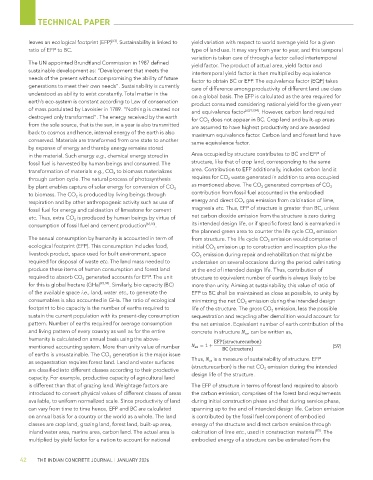
           and living pattern of every country as well as for the entire   concrete in structure N es , can be written as,
           humanity is calculated on annual basis using the above-
           mentioned accounting system. More than unity value of number                                          (59)
           of earths is unsustainable. The CO 2  generation is the major issue
           as sequestration requires forest land. Land and water surfaces   Thus, N es  is a measure of sustainability of structure. EFP
           are classified into different classes according to their productive   (structurecarbon) is the net CO 2  emission during the intended
           capacity. For example, productive capacity of agricultural land   design life of the structure.
           is different than that of grazing land. Weightage factors are   The EFP of structure in terms of forest land required to absorb
           introduced to convert physical values of different classes of areas   the carbon emission, comprises of the forest land requirements
           available, to uniform normalized scale. Since productivity of land   during initial construction phase and that during service phase,
           can vary from time to time hence, EFP and BC are calculated   spanning up to the end of intended design life. Carbon emission
           on annual basis for a country or the world as a whole. The land   is contributed by the fossil fuel component of embodied
           classes are crop land, grazing land, forest land, built-up area,   energy of the structure and direct carbon emission through
           inland water area, marine area, carbon land. The actual area is   calcination of lime etc., used in construction material . The
                                                                                                           [95]
           multiplied by yield factor for a nation to account for national   embodied energy of a structure can be estimated from the


        42    THE INDIAN CONCRETE JOURNAL | JANUARY 2026

