


Page 38 - ICJ Jan 2026
P. 38
TECHNICAL PAPER


           information on embodied energy of individual material used in   cementitious material and other low carbon cements are used
           the structure [96,97] . Knowing the quantities used in construction   in concrete, this factor may be multiplied with national clinker
           and that used during repair against serviceability limit failure,   factor (NCF), which is of the order of 0.7 - 0.75 in India now. NCF
                                               [95]
           life cycle embodied energy can be estimated . The initial   varies in temporal dimension. NCF is 1 for OPC quantity used
           embodied energy (IEE) of concrete per cubic meter can be   directly in construction when no supplementary cementitious
           written as,                                            material is added at site.

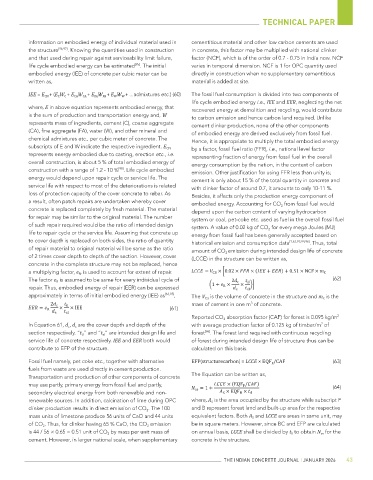
           IEE = E CN  + (E C W C  + E CA W CA  + E FA W FA  + E W W W  + ...admixtures etc.) (60)  The fossil fuel consumption is divided into two components of
                                                                  life cycle embodied energy i.e., IEE and EER, neglecting the net
           where, E in above equation represents embodied energy, that   recovered energy at demolition and recycling, would contribute
           is the sum of production and transportation energy and, W   to carbon emission and hence carbon land required. Unlike
           represents mass of ingredients, cement (C), coarse aggregate   cement clinker production, none of the other components
           (CA), fine aggregate (FA), water (W), and other mineral and   of embodied energy are derived exclusively from fossil fuel.
           chemical admixtures etc., per cubic meter of concrete. The   Hence, it is appropriate to multiply the total embodied energy

                                                                  by a factor, fossil fuel ratio (FFR), i.e., national level factor
           subscripts of E and W indicate the respective ingredient. E CN
           represents energy embodied due to casting, erection etc., i.e.   representing fraction of energy from fossil fuel in the overall
           overall construction, is about 5 % of total embodied energy of   energy consumption by the nation, in the context of carbon
           construction with a range of 1.2 - 10 % . Life cycle embodied   emission. Other justification for using FFR less than unity is;
                                         [98]
           energy would depend upon repair cycle or service life. The   cement is only about 15 % of the total quantity in concrete and
           service life with respect to most of the deteriorations is related   with clinker factor of around 0.7, it amounts to only 10-11 %.
           loss of protection capacity of the cover concrete to rebar. As   Besides, it affects only the production energy component of
           a result, often patch repairs are undertaken whereby cover   embodied energy. Accounting for CO 2  from fossil fuel would
           concrete is replaced completely by fresh material. The material   depend upon the carbon content of varying hydrocarbon
           for repair may be similar to the original material. The number   system or coal, pet-coke etc. used as fuel in the overall fossil fuel
           of such repair required would be the ratio of intended design   system. A value of 0.02 kg of CO 2  for every mega Joules (MJ)
           life to repair cycle or the service life. Assuming that concrete up   energy from fossil fuel has been generally accepted based on
           to cover depth is replaced on both sides, the ratio of quantity   historical emission and consumption data [1,63,93,94,96] . Thus, total
           of repair material to original material will be same as the ratio   amount of CO 2  emission during intended design life of concrete
           of 2 times cover depth to depth of the section. However, cover   (LCCE) in the structure can be written as,
           concrete in the complete structure may not be replaced, hence
           a multiplying factor, e R , is used to account for extent of repair.
           The factor e R  is assumed to be same for every individual cycle of                                    (62)
           repair. Thus, embodied energy of repair (EER) can be expressed
           approximately in terms of initial embodied energy (IEE) as [63,95] ,  The V CS  is the volume of concrete in the structure and m C  is the
                                                                  mass of cement in one m  of concrete.
                                                                                      3
                                                          (61)
                                                                                                                   2
                                                                  Reported CO 2  absorption factor (CAF) for forest is 0.095 kg/m
           In Equation 61, d c , d s  are the cover depth and depth of the   with average production factor of 0.125 kg of timber/m  of
                                                                                                             2
                                                                      [96]
           section respectively. “t il ” and “t sl ” are intended design life and   forest . The forest land required with continuous recycling
           service life of concrete respectively. IEE and EER both would   of forest during intended design life of structure thus can be
           contribute to EFP of the structure.                    calculated on this basis.
           Fossil fuel namely, pet coke etc., together with alternative   EFP(structurecarbon) = LCCE × EQF F /CAF   (63)
           fuels from waste are used directly in cement production.
           Transportation and production of other components of concrete   The Equation can be written as,
           may use partly, primary energy from fossil fuel and partly,                                           (64)
           secondary electrical energy from both renewable and non-
           renewable sources. In addition, calcination of lime during OPC   where, A S  is the area occupied by the structure while subscript F
           clinker production results in direct emission of CO 2 . The 100   and B represent forest land and built-up area for the respective
           mass units of limestone produce 56 units of CaO and 44 units   equivalent factors. Both A S  and LCCE are areas in same unit, may
           of CO 2 . Thus, for clinker having 65 % CaO, the CO 2  emission   be in square meters. However, since BC and EFP are calculated
           is 44 / 56 × 0.65 = 0.51 unit of CO 2  by mass per unit mass of   on annual basis, LCCE shall be divided by t il  to obtain N es  for the
           cement. However, in larger national scale, when supplementary   concrete in the structure.


                                                                            THE INDIAN CONCRETE JOURNAL | JANUARY 2026  43

