


Page 14 - ICJ Jan 2026
P. 14
TECHNICAL PAPER


           [16]  Patel, A. K. (2024). “Investigation and optimization   clay”, Cement and Concrete Composites, Vol. 136, No. 2,
               of concrete 3D printing parameters for enhancing       Article No. 104853.
               printability”, MS Thesis, Indian Institute of Technology (IIT),
               Madras.                                            [20]  Bhattacherjee, S., Jain, S., and Santhanam, M. (2023).
                                                                      “Developing 3D printable and buildable limestone
           [17]  Ducoulombier, N., Mesnil, R., Carneau, P., Demont, L.,   calcined clay-based cement composites with higher
               Bessaies-Bey, H., Caron, J. F., and Roussel, N. (2021).    aggregate content”, Construction and Building Materials,
               “The ‘Slugs-Test’ for extrusion-based additive         Vol. 376, No. 5, Article No. 131058.
               manufacturing: Protocol, analysis, and practical limits,”
               Cement and Concrete Composites, Vol. 121,          [21]  Haripan, V., Senthilnathan, S., Santhanam, M., and Raphael,
               Article No. 104074.                                    B. (2025). “Printability assessment of concrete 3D printed
                                                                      elements with recycled fine aggregate”, Construction and
           [18]  Bhattacherjee, S., Jain, S., and Santhanam, M. (2022).
               “Criticality of microstructure evolution at an early age on   Building Materials, Vol. 500, Article No. 144187, https://doi.
               the buildability of an accelerated 3D printable concrete”,   org/10.1016/j.conbuildmat.2025.144187
               Construction and Building Materials, Vol. 342, Part A,   [22]  Nanthagopalan, P., and Santhanam, M. (2009).
               No. 8, Article No. 127970.                             “Experimental investigations on the influence of paste

           [19]  Bhattacherjee, S., Jain, S., and Santhanam, M. (2023).   composition and content on the properties of self-
               “Criticality of binder aggregate interaction for buildability   compacting concrete”, Construction and Building
               of 3D printed concrete containing limestone calcined   Materials, Vol. 23, No. 11, pp. 3443-3449.


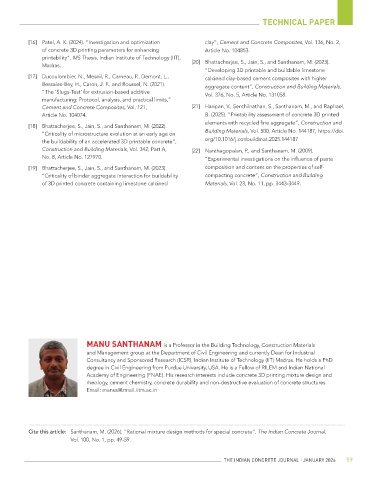
                              MANU SANTHANAM is a Professor in the Building Technology, Construction Materials
                              and Management group at the Department of Civil Engineering and currently Dean for Industrial
                              Consultancy and Sponsored Research (ICSR), Indian Institute of Technology (IIT) Madras. He holds a PhD
                              degree in Civil Engineering from Purdue University, USA. He is a Fellow of RILEM and Indian National
                              Academy of Engineering (FNAE). His research interests include concrete 3D printing mixture design and
                              rheology, cement chemistry, concrete durability and non-destructive evaluation of concrete structures.
                              Email: manus@zmail.iitm.ac.in


           Cite this article:  Santhanam, M. (2026). “Rational mixture design methods for special concrete”, The Indian Concrete Journal,
                         Vol. 100, No. 1, pp. 49-59.


                                                                            THE INDIAN CONCRETE JOURNAL | JANUARY 2026  59

