


Page 10 - ICJ Jan 2026
P. 10
TECHNICAL PAPER


           Table 5: Design of SCC with optimized paste and        aggregates such as hematite, magnetite, ilmenite etc. One
           aggregate combinations for different w/b               problem that is encountered with high density concrete is the
                                                                  segregation of the heavy aggregates, which requires a careful
            W/P   POWDER    PASTE   AGGREGATE   SLUMP   T 500  (s)
            RATIO  CONTENT  CONTENT  CONTENT     FLOW             mixture design of the paste fraction. Excess paste is not really
            (Vol.)  (kg/m )  (lit. /m )  (lit. /m )  (mm)         an option since it would lower the density. Hence, the design
                       3
                                3
                                           3
             0.8    550      388       612        555     6.0     includes a careful control of the packing of the heavy aggregate
             0.9    521      388       612        600     5.0     by choosing optimal particle distributions for the coarse and
             1.0    495      388       612        600     4.0     fine fractions  [12] . Further, the viscosity of the cement paste
             1.1    472      388       612        610     1.9     can be controlled by the judicious use of SP and VMA. While
             1.2    450      388       612        635     1.0     segregation control can be achieved by these optimal design
                                                                  methods, there are several applications where it is desirable to
           with the optimal paste composition and aggregate gradation,   pump the high density concrete, in order to facilitate the rapid
           the flowability as well as the compressive strength improves with   construction of such structures. This necessitates the adoption of
           packing density. Further, the design of SCC with different w/b   the rheology control approach for the design of HDC.
           (from 0.8-1.2) with optimized dosages of SP and VMA, keeping
           the paste content constant at 388 kg/m , results in concrete   The slump test can sometimes lead to an erroneous judgment
                                          3
           with controlled self-compactability, as presented in Table 5. As   about the pumpability characteristics of HDC. While it gives
           expected, the slump flow (which is indicative of the yield stress)   an assessment of the consistency of the concrete, it is not able
           increases and the T 500  (which is indicative of plastic viscosity)   to simulate the effect of the lubrication layer caused by the
                                                                  excess paste in the concrete that leads to improved pumping
           decreases when the w/b is increased.
                                                                  characteristics. A simple approach to the determination of
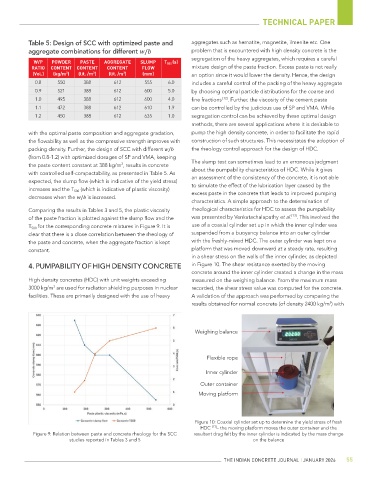
           Comparing the results in Tables 3 and 5, the plastic viscosity   rheological characteristics for HDC to assess the pumpability
                                                                                                   [13]
           of the paste fraction is plotted against the slump flow and the   was presented by Venkatachalapathy et al. . This involved the
           T 500  for the corresponding concrete mixtures in Figure 9. It is   use of a coaxial cylinder set up in which the inner cylinder was
           clear that there is a close correlation between the rheology of   suspended from a buoyancy balance into an outer cylinder
           the paste and concrete, when the aggregate fraction is kept   with the freshly-mixed HDC. The outer cylinder was kept on a
           constant.                                              platform that was moved downward at a steady rate, resulting
                                                                  in a shear stress on the walls of the inner cylinder, as depicted
           4. PUMPABILITY OF HIGH DENSITY CONCRETE                in Figure 10. The shear resistance exerted by the moving
                                                                  concrete around the inner cylinder created a change in the mass
           High density concretes (HDC) with unit weights exceeding   measured on the weighing balance. From the maximum mass
                   3
           3000 kg/m  are used for radiation shielding purposes in nuclear   recorded, the shear stress value was computed for the concrete.
           facilities. These are primarily designed with the use of heavy   A validation of the approach was performed by comparing the
                                                                                                                3
                                                                  results obtained for normal concrete (of density 2400 kg/m ) with


                                                                   Weighing balance


                                                                       Flexible rope

                                                                      Inner cylinder
                                                                     Outer container
                                                                    Moving platform


                                                                   Figure 10: Coaxial cylinder set up to determine the yield stress of fresh
                                                                        [13]
                                                                     HDC  – the moving platform moves the outer container and the
            Figure 9: Relation between paste and concrete rheology for the SCC   resultant drag felt by the inner cylinder is indicated by the mass change
                        studies reported in Tables 3 and 5                            on the balance

                                                                            THE INDIAN CONCRETE JOURNAL | JANUARY 2026  55

