


Page 8 - ICJ Jan 2026
P. 8
TECHNICAL PAPER


                                                    [8]
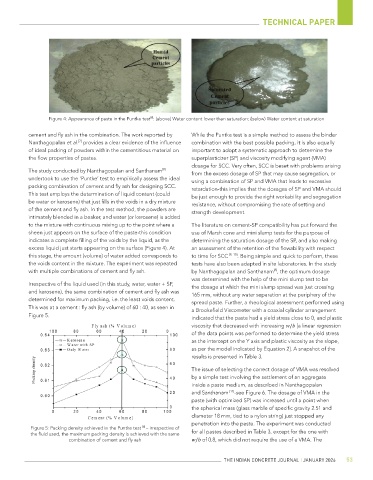
                 Figure 4: Appearance of paste in the Puntke test : (above) Water content lower than saturation; (below) Water content at saturation

           cement and fly ash in the combination. The work reported by   While the Puntke test is a simple method to assess the binder
                           [7]
           Nanthagopalan et al.  provides a clear evidence of the influence   combination with the best possible packing, it is also equally
           of ideal packing of powders within the cementitious material on   important to adopt a systematic approach to determine the
           the flow properties of pastes.                         superplasticizer (SP) and viscosity modifying agent (VMA)
                                                                  dosage for SCC. Very often, SCC is beset with problems arising
           The study conducted by Nanthagopalan and Santhanam     from the excess dosage of SP that may cause segregation, or
                                                        [8]
           undertook to use the ‘Puntke’ test to empirically assess the ideal   using a combination of SP and VMA that leads to excessive
           packing combination of cement and fly ash for designing SCC.   retardation-this implies that the dosages of SP and VMA should
           This test employs the determination of liquid content (could   be just enough to provide the right workability and segregation
           be water or kerosene) that just fills in the voids in a dry mixture   resistance, without compromising the rate of setting and
           of the cement and fly ash. In the test method, the powders are   strength development.
           intimately blended in a beaker, and water (or kerosene) is added
           to the mixture with continuous mixing up to the point where a   The literature on cement-SP compatibility has put forward the
           sheen just appears on the surface of the paste-this condition   use of Marsh cone and mini slump tests for the purpose of
           indicates a complete filling of the voids by the liquid, as the   determining the saturation dosage of the SP, and also making
           excess liquid just starts appearing on the surface (Figure 4). At   an assessment of the retention of the flowability with respect
           this stage, the amount (volume) of water added corresponds to   to time for SCC  [9, 10] . Being simple and quick to perform, these
           the voids content in the mixture. The experiment was repeated   tests have also been adapted in site laboratories. In the study
           with multiple combinations of cement and fly ash.      by Nanthagopalan and Santhanam , the optimum dosage
                                                                                             [8]
                                                                  was determined with the help of the mini slump test to be
           Irrespective of the liquid used (in this study, water, water + SP,   the dosage at which the mini slump spread was just crossing
           and kerosene), the same combination of cement and fly ash was   165 mm, without any water separation at the periphery of the
           determined for maximum packing, i.e. the least voids content.   spread paste. Further, a rheological assessment performed using
           This was at a cement : fly ash (by volume) of 60 : 40, as seen in   a Brookefield Viscometer with a coaxial cylinder arrangement
           Figure 5.
                                                                  indicated that the paste had a yield stress close to 0, and plastic
                                                                  viscosity that decreased with increasing w/b [a linear regression
                                                                  of the data points was performed to determine the yield stress
                                                                  as the intercept on the Y axis and plastic viscosity as the slope,
                                                                  as per the model indicated by Equation 2]. A snapshot of the
                                                                  results is presented in Table 3.

                                                                  The issue of selecting the correct dosage of VMA was resolved
                                                                  by a simple test involving the settlement of an aggregate
                                                                  inside a paste medium, as described in Nanthagopalan
                                                                  and Santhanam  [11] -see Figure 6. The dosage of VMA in the
                                                                  paste (with optimized SP) was increased until a point when
                                                                  the spherical mass (glass marble of specific gravity 2.51 and
                                                                  diameter 18 mm, tied to a nylon string) just stopped any
                                                                  penetration into the paste. The experiment was conducted
           Figure 5: Packing density achieved in the Puntke test  – irrespective of
                                                 [8]
           the fluid used, the maximum packing density is achieved with the same   for all pastes described in Table 3, except for the one with
                        combination of cement and fly ash         w/b of 0.8, which did not require the use of a VMA. The

                                                                            THE INDIAN CONCRETE JOURNAL | JANUARY 2026  53

