


Page 12 - ICJ Jan 2026
P. 12
TECHNICAL PAPER


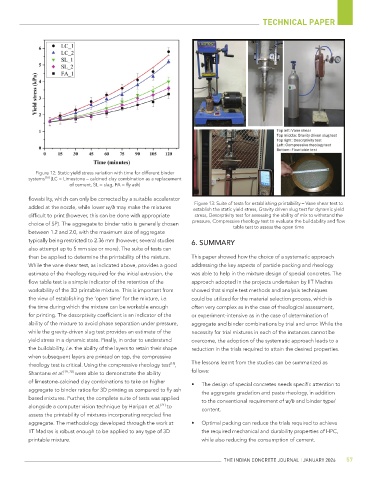
             Figure 12: Static yield stress variation with time for different binder
           systems  (LC = Limestone – calcined clay combination as a replacement
                [16]
                        of cement, SL = slag, FA = fly ash)
           flowability, which can only be corrected by a suitable accelerator
                                                                   Figure 13: Suite of tests for establishing printability – Vane shear test to
           added at the nozzle, while lower w/b may make the mixtures   establish the static yield stress, Gravity driven slug test for dynamic yield
           difficult to print (however, this can be done with appropriate   stress, Desorptivity test for assessing the ability of mix to withstand the
                                                                  pressure, Compressive rheology test to evaluate the buildability and flow
           choice of SP). The aggregate to binder ratio is generally chosen
                                                                                table test to assess the open time
           between 1.2 and 2.0, with the maximum size of aggregate
           typically being restricted to 2.36 mm (however, several studies
                                                                  6. SUMMARY
           also attempt up to 5 mm size or more). The suite of tests can
           then be applied to determine the printability of the mixture.   This paper showed how the choice of a systematic approach
           While the vane shear test, as indicated above, provides a good   addressing the key aspects of particle packing and rheology
           estimate of the rheology required for the initial extrusion, the   was able to help in the mixture design of special concretes. The
           flow table test is a simple indicator of the retention of the   approach adopted in the projects undertaken by IIT Madras
           workability of the 3D printable mixture. This is important from   showed that simple test methods and analysis techniques
           the view of establishing the ‘open time’ for the mixture, i.e.   could be utilized for the material selection process, which is
           the time during which the mixture can be workable enough   often very complex as in the case of rheological assessment,
           for printing. The desorptivity coefficient is an indicator of the   or experiment-intensive as in the case of determination of
           ability of the mixture to avoid phase separation under pressure,   aggregate and binder combinations by trial and error. While the
           while the gravity-driven slug test provides an estimate of the   necessity for trial mixtures in each of the instances cannot be
           yield stress in a dynamic state. Finally, in order to understand   overcome, the adoption of the systematic approach leads to a
           the buildability, i.e. the ability of the layers to retain their shape   reduction in the trials required to attain the desired properties.
           when subsequent layers are printed on top, the compressive
                                                          [18]
           rheology test is critical. Using the compressive rheology test ,   The lessons learnt from the studies can be summarized as
           Shantanu et al. [19, 20]  were able to demonstrate the ability   follows:
           of limestone-calcined clay combinations to take on higher   •   The design of special concretes needs specific attention to
           aggregate to binder ratios for 3D printing as compared to fly ash   the aggregate gradation and paste rheology, in addition
           based mixtures. Further, the complete suite of tests was applied   to the conventional requirement of w/b and binder type/
           alongside a computer vision technique by Haripan et al.  to   content.
                                                       [21]
           assess the printability of mixtures incorporating recycled fine
           aggregate. The methodology developed through the work at   •   Optimal packing can reduce the trials required to achieve
           IIT Madras is robust enough to be applied to any type of 3D   the required mechanical and durability properties of HPC,
           printable mixture.                                        while also reducing the consumption of cement.


                                                                            THE INDIAN CONCRETE JOURNAL | JANUARY 2026  57

