


Page 7 - ICJ Jan 2026
P. 7
TECHNICAL PAPER


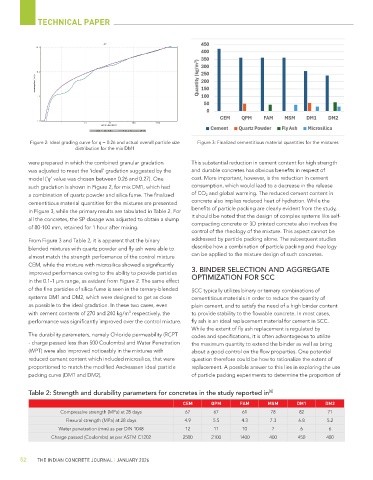
           Figure 2: Ideal grading curve for q = 0.26 and actual overall particle size   Figure 3: Finalized cementitious material quantities for the mixtures
                          distribution for the mix DM1

           were prepared in which the combined granular gradation   This substantial reduction in cement content for high strength
           was adjusted to meet the ‘ideal’ gradation suggested by the   and durable concretes has obvious benefits in respect of
           model (‘q’ value was chosen between 0.26 and 0.27). One   cost. More important, however, is the reduction in cement
           such gradation is shown in Figure 2, for mix DM1, which had   consumption, which would lead to a decrease in the release
           a combination of quartz powder and silica fume. The finalized   of CO 2  and global warming. The reduced cement content in
           cementitious material quantities for the mixtures are presented   concrete also implies reduced heat of hydration. While the
           in Figure 3, while the primary results are tabulated in Table 2. For   benefits of particle packing are clearly evident from the study,
           all the concretes, the SP dosage was adjusted to obtain a slump   it should be noted that the design of complex systems like self-
                                                                  compacting concrete or 3D printed concrete also involves the
           of 80-100 mm, retained for 1 hour after mixing.
                                                                  control of the rheology of the mixture. This aspect cannot be
           From Figure 3 and Table 2, it is apparent that the binary   addressed by particle packing alone. The subsequent studies
           blended mixtures with quartz powder and fly ash were able to   describe how a combination of particle packing and rheology
           almost match the strength performance of the control mixture   can be applied to the mixture design of such concretes.
           CEM, while the mixture with microsilica showed a significantly
           improved performance owing to the ability to provide particles   3. BINDER SELECTION AND AGGREGATE
           in the 0.1-1 µm range, as evident from Figure 2. The same effect   OPTIMIZATION FOR SCC
           of the fine particles of silica fume is seen in the ternary-blended   SCC typically utilizes binary or ternary combinations of
           systems DM1 and DM2, which were designed to get as close   cementitious materials in order to reduce the quantity of
           as possible to the ideal gradation. In these two cases, even   plain cement, and to satisfy the need of a high binder content
                                             3
           with cement contents of 270 and 240 kg/m  respectively, the   to provide stability to the flowable concrete. In most cases,
           performance was significantly improved over the control mixture.  fly ash is an ideal replacement material for cement in SCC.
                                                                  While the extent of fly ash replacement is regulated by
           The durability parameters, namely Chloride permeability (RCPT   codes and specifications, it is often advantageous to utilize
           - charge passed less than 500 Coulombs) and Water Penetration   the maximum quantity to extend the binder as well as bring
           (WPT) were also improved noticeably in the mixtures with   about a good control on the flow properties. One potential
           reduced cement content which included microsilica, that were   question therefore could be how to rationalize the extent of
           proportioned to match the modified Andreassen ideal particle   replacement. A possible answer to this lies in exploring the use
           packing curve (DM1 and DM2).                           of particle packing experiments to determine the proportion of


           Table 2: Strength and durability parameters for concretes in the study reported in [6]
                                                               CEM      QPM       FAM      MSM       DM1       DM2
                     Compressive strength (MPa) at 28 days     67        67        61       78        82       71
                       Flexural strength (MPa) at 28 days      4.9       5.5      4.3       7.3       6.8      5.2
                     Water penetration (mm) as per DIN 1048    12        11        10        7        6         6
                  Charge passed (Coulombs) as per ASTM C1202   2500     2100      1400      400      450       400


        52    THE INDIAN CONCRETE JOURNAL | JANUARY 2026

