


Page 9 - ICJ Jan 2026
P. 9
TECHNICAL PAPER


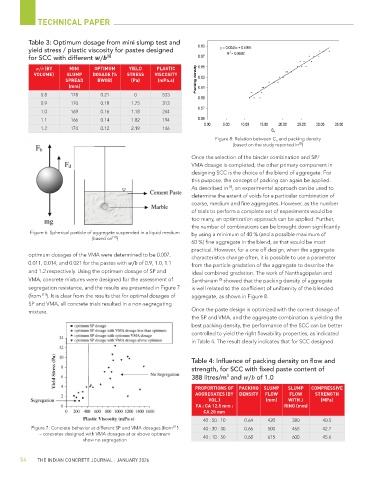
           Table 3: Optimum dosage from mini slump test and
           yield stress / plastic viscosity for pastes designed
           for SCC with different w/b [8]

             w/b (BY    MINI     OPTIMUM     YIELD    PLASTIC
            VOLUME)     SLUMP   DOSAGE (%   STRESS   VISCOSITY
                       SPREAD     BWOB)      (Pa)     (mPa.s)
                        (mm)
               0.8       178       0.21       0         533
               0.9       170       0.18      1.75       313
               1.0       169       0.16      1.18       244
               1.1       166       0.14      1.82       194
               1.2       174       0.12      2.19       146

                                                                          Figure 8: Relation between C u  and packing density
                                                                                                      [3]
                                                                               (based on the study reported in )
                                                                  Once the selection of the binder combination and SP/
                                                                  VMA dosage is completed, the other primary component in
                                                                  designing SCC is the choice of the blend of aggregate. For
                                                                  this purpose, the concept of packing can again be applied.
                                                                  As described in , an experimental approach can be used to
                                                                               [3]
                                                                  determine the extent of voids for a particular combination of
                                                                  coarse, medium and fine aggregates. However, as the number
                                                                  of trials to perform a complete set of experiments would be
                                                                  too many, an optimization approach can be applied. Further,
                                                                  the number of combinations can be brought down significantly
           Figure 6: Spherical particle of aggregate suspended in a liquid medium   by using a minimum of 40 % (and a possible maximum of
                                (based on )
                                       [11]
                                                                  60 %) fine aggregate in the blend, as that would be most
                                                                  practical. However, for a one off design, when the aggregate
           optimum dosages of the VMA were determined to be 0.007,
                                                                  characteristics change often, it is possible to use a parameter
           0.011, 0.014, and 0.021 for the pastes with w/b of 0.9, 1.0, 1.1   from the particle gradation of the aggregate to describe the
           and 1.2 respectively. Using the optimum dosage of SP and   ideal combined gradation. The work of Nanthagopalan and
           VMA, concrete mixtures were designed for the assessment of   Santhanam  showed that the packing density of aggregate
                                                                            [3]
           segregation resistance, and the results are presented in Figure 7   is well related to the coefficient of uniformity of the blended
           (from  [11] ). It is clear from the results that for optimal dosages of   aggregate, as shown in Figure 8.
           SP and VMA, all concrete trials resulted in a non-segregating
           mixture.                                               Once the paste design is optimized with the correct dosage of
                                                                  the SP and VMA, and the aggregate combination is yielding the
                                                                  best packing density, the performance of the SCC can be better
                                                                  controlled to yield the right flowability properties, as indicated
                                                                  in Table 4. The result clearly indicates that for SCC designed


                                                                  Table 4: Influence of packing density on flow and
                                                                  strength, for SCC with fixed paste content of
                                                                             3
                                                                  388 litres/m  and w/b of 1.0
                                                                   PROPORTIONS OF  PACKING  SLUMP   SLUMP   COMPRESSIVE
                                                                   AGGREGATES (BY  DENSITY  FLOW   FLOW    STRENGTH
                                                                       VOL.)               (mm)   WITH J     (MPa)
                                                                   FA : CA 12.5 mm :             RING (mm)
                                                                      CA 20 mm
                                                                      40 : 50 : 10  0.64   420      380       40.5
            Figure 7: Concrete behavior at different SP and VMA dosages (from )  40 : 30 : 30  0.66  500  465  42.7
                                                           [11]
              – concretes designed with VMA dosages at or above optimum
                             show no segregation                      40 : 10 : 50  0.68   615      600       45.6

        54    THE INDIAN CONCRETE JOURNAL | JANUARY 2026

