


Page 5 - ICJ Jan 2026
P. 5
TECHNICAL PAPER


           Table 1: Complex combination of characteristics necessary in special concrete

            TYPE OF CONCRETE  FRESH PROPERTY                                    HARDENED PROPERTY
            High strength / high   Workability requirements may be different based on application;   Typically used aggregate gradations may not
            performance concrete  however, achieving and maintaining workability at low w/c is   be optimized with respect to the needs of high
                              difficult-optimizing of chemical admixture combination and dosage   strength concrete; durability requirements may not
                                                 is important                   be met just with low w/c, and would require the use
                                                                                 of suitable supplementary cementitious materials
              Self-compacting   Control of segregation for highly flowable concrete needs to   Optimizing the mixture design to achieve a
                concrete         be achieved by the use of suitable chemical and/or mineral   range of concrete strengths (mainly in the low to
                              additives; further, the material needs to exhibit diagonally opposite   moderate range) may be difficult because of the
                             characteristics while in movement (low yield stress and viscosity) and   usually low w/b used for such concretes
                              while at rest (high yield stress and viscosity)-therefore, selection and
                              optimization of chemical admixtures plays a large role; additionally,
                                 the control of workability needs to be exercised in different
                                           applications to avoid cracking
            High density concrete  Because of the high density nature of the aggregates, controlling the   Distribution of aggregate across the cross section
                              segregation at high workability can be difficult-aggregate gradation   could be non-uniform, leading to strength
                             and chemical admixture selection play a crucial role in the control of   variations-this requires a careful control of the
                                                 the behavior                              particle gradations
            3D printed concrete  Contradictory set of characteristics need to evolve in a short time   The concrete needs to evolve ‘green’ strength and
                             span: for pumping and material delivery, the concrete needs to have   stiffness, that gives it the ability to stay in place
                              low yield stress and plastic viscosity; when the material is extruded   without failure; on the other hand, the interface
                               through the nozzle, it needs a moderate yield stress, but when   between layers requires the material to be relatively
                              layer-on-layer deposition occurs, considerable increase in the yield   fresh in order for the bond to be good
                               stress and viscosity of the material needs to happen; therefore, a
                             proper control needs to be exercised on the selection of appropriate
                                       chemical admixtures and printing strategy

           A common particle packing model used in concrete studies is   The exponent q value in the Andreassen equation could be
                                     [2]
           the Modified Andreassen model  which is preferred because   varied from 0.21 to 0.37 depending upon various workability and
           of its relevance, simplicity and availability. The ideal gradation   strength requirements. The previously available EMMA software
           as per the Modified Andreassen model is defined in terms of   was based on this model. However, the model can be easily
           Equation 1.                                            coded into a spreadsheet to obtain the parameters for the ideal

                         q
                                 q
                      q
                              q
           CPFT = 100 * (d -d m ) / (D -d m )           (1)       gradation.
           where, CPFT is the Cumulative (Volume) Percent Finer than,  Studies on particle packing involve investigations into the
           d is the particle size,                                problem of selecting appropriate sizes and proportions of
                                                                  particulate materials to get the suitable combination for optimal
           d m  is the minimum particle size of the distribution,
                                                                  packing. As the particle packing is directly controlled by the
           D is the maximum particle size, and                    particle size distribution of the material, a system of aggregate
           q is the distribution coefficient (the exponent).      or powders can never pack better than the maximum possible


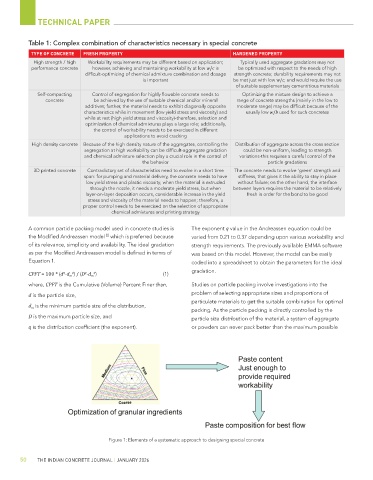
                                      Figure 1: Elements of a systematic approach to designing special concrete


        50    THE INDIAN CONCRETE JOURNAL | JANUARY 2026

