


Page 5 - ICJ Feb Openaccess 2026
P. 5
TECHNICAL PAPER


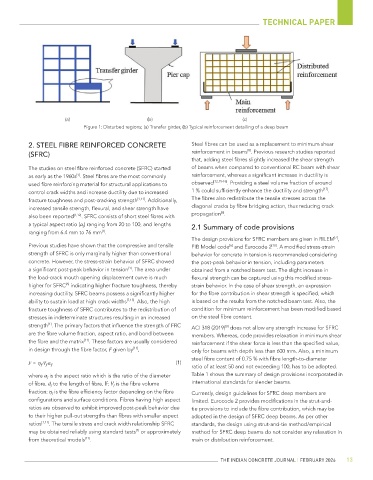
                       (a)                         (b)                             (c)
                             Figure 1: Disturbed regions; (a) Transfer girder, (b) Typical reinforcement detailing of a deep beam


           2. STEEL FIBRE REINFORCED CONCRETE                     Steel fibres can be used as a replacement to minimum shear
                                                                                    [8]
                                                                  reinforcement in beams . Previous research studies reported
           (SFRC)
                                                                  that, adding steel fibres slightly increased the shear strength
           The studies on steel fibre reinforced concrete (SFRC) started   of beams when compared to conventional RC beam with shear
                           [1]
           as early as the 1960s . Steel fibres are the most commonly   reinforcement, whereas a significant increase in ductility is
           used fibre reinforcing material for structural applications to   observed [12,15-16] . Providing a steel volume fraction of around
                                                                                                              [17]
           control crack widths and increase ductility due to increased   1 % could sufficiently enhance the ductility and strength .
           fracture toughness and post-cracking strength [1,11] . Additionally,   The fibres also redistribute the tensile stresses across the
           increased tensile strength, flexural, and shear strength have   diagonal cracks by fibre bridging action, thus reducing crack
                                                                            [6]
           also been reported [1,12] . SFRC consists of short steel fibres with   propagation .
           a typical aspect ratio (α f ) ranging from 20 to 100, and lengths   2.1 Summary of code provisions
                                   [1]
           ranging from 6.4 mm to 76 mm .
                                                                  The design provisions for SFRC members are given in RILEM ,
                                                                                                                  [7]
           Previous studies have shown that the compressive and tensile   FIB Model code  and Eurocode 2 . A modified stress-strain
                                                                                             [10]
                                                                              [6]
           strength of SFRC is only marginally higher than conventional   behavior for concrete in tension is recommended considering
           concrete. However, the stress-strain behavior of SFRC showed   the post-peak behavior in tension, including parameters
                                            [1]
           a significant post-peak behavior in tension . The area under   obtained from a notched beam test. The slight increase in
           the load-crack mouth opening displacement curve is much   flexural strength can be captured using this modified stress-
                       [6]
           higher for SFRC  indicating higher fracture toughness, thereby   strain behavior. In the case of shear strength, an expression
           increasing ductility. SFRC beams possess a significantly higher   for the fibre contribution in shear strength is specified, which
           ability to sustain load at high crack widths [7,13] . Also, the high   is based on the results from the notched beam test. Also, the
           fracture toughness of SFRC contributes to the redistribution of   condition for minimum reinforcement has been modified based
           stresses in indeterminate structures resulting in an increased   on the steel fibre content.
           strength . The primary factors that influence the strength of FRC   ACI 318 (2019)  does not allow any strength increase for SFRC
                 [1]
                                                                             [8]
           are the fibre volume fraction, aspect ratio, and bond between   members. Whereas, code provides relaxation in minimum shear
           the fibre and the matrix . These factors are usually considered   reinforcement if the shear force is less than the specified value,
                             [11]
                                              [11]
           in design through the fibre factor, F given by ,       only for beams with depth less than 600 mm. Also, a minimum
                                                                  steel fibre content of 0.75 % with fibre length-to-diameter
                                                            (1)
                                                                  ratio of at least 50 and not exceeding 100, has to be adopted.
           where α f  is the aspect ratio which is the ratio of the diameter   Table 1 shows the summary of design provisions incorporated in
           of fibre, d f  to the length of fibre, lf; V f  is the fibre volume   international standards for slender beams.
           fraction; η f  is the fibre efficiency factor depending on the fibre   Currently, design guidelines for SFRC deep members are
           configurations and surface conditions. Fibres having high aspect   limited. Eurocode 2 provides modifications in the strut-and-
           ratios are observed to exhibit improved post-peak behavior due   tie provisions to include the fibre contribution, which may be
           to their higher pull-out strengths than fibres with smaller aspect   adopted in the design of SFRC deep beams. As per other
           ratios [1,11] . The tensile stress and crack width relationship SFRC   standards, the design using strut-and-tie method/empirical
           may be obtained reliably using standard tests  or approximately   method for SFRC deep beams do not consider any relaxation in
                                               [7]
                              [11]
           from theoretical models .                              main or distribution reinforcement.

                                                                           THE INDIAN CONCRETE JOURNAL | FEBRUARY 2026  13

