


Page 6 - ICJ Feb Openaccess 2026
P. 6
TECHNICAL PAPER


           Table 1: International design standards recommendation summary on SFRC for slender beams

                DESIGN         TYPE OF FIBRES   FLEXURAL STRENGTH EVALUATION/   SHEAR       MINIMUM     MINIMUM SHEAR
              STANDARDS                                   DESIGN              STRENGTH    LONGITUDINAL   REINFORCEMENT
                                                                             EVALUATION /    STEEL       RELAXATION
                             STEEL     OTHER        COMP.     TENSION DESIGN   DESIGN      RELAXATION
                             FIBRE     FIBRES   DESIGN STRESS-  STRESS-STRAIN
                                                 STRAIN CURVE     CURVE
               AASHTO [9]      ü         –            –             –             –            –             –
                RILEM [7]      ü         –           ü              ü            ü             –             –
               ACI 318 [8]     ü         –            –             –             –            –             ü
                 Fib [6]       ü         –           ü              ü            ü             –             –
                EC2 [10]       ü         –           ü              ü            ü             ü*            ü
           * Not applicable for beams


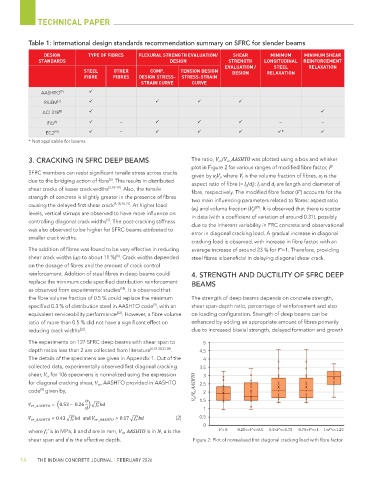
           3. CRACKING IN SFRC DEEP BEAMS                         The ratio, V cr /V cr _AASHTO was plotted using a box and whisker
                                                                  plot in Figure 2 for various ranges of modified fibre factor, F’
           SFRC members can resist significant tensile stress across cracks   given by α f V f , where V f  is the volume fraction of fibres, α f  is the
                                      [5]
           due to the bridging action of fibre . This results in distributed   aspect ratio of fibre (= l f /d f ); l f  and d f  are length and diameter of
           shear cracks of lesser crack widths [5,18-19] . Also, the tensile
                                                                  fibre, respectively. The modified fibre factor (F’) accounts for the
           strength of concrete is slightly greater in the presence of fibres   two main influencing parameters related to fibres: aspect ratio
           causing the delayed first shear crack [5,18,20-21] . At higher load   (α f ) and volume fraction (V f ) . It is observed that there is scatter
                                                                                       [29]
           levels, vertical stirrups are observed to have more influence on
                                                                  in data (with a coefficient of variation of around 0.31), possibly
           controlling diagonal crack widths . The post-cracking stiffness   due to the inherent variability in FRC concrete and observational
                                     [5]
           was also observed to be higher for SFRC beams attributed to   error in diagonal cracking load. A gradual increase in diagonal
           smaller crack widths.
                                                                  cracking load is observed, with increase in fibre factor, with an
           The addition of fibres was found to be very effective in reducing   average increase of around 23 % for F’≈1. Therefore, providing
           shear crack widths (up to about 11 %) . Crack widths depended   steel fibres is beneficial in delaying diagonal shear crack.
                                        [5]
           on the dosage of fibres and the amount of crack control
           reinforcement. Addition of steel fibres in deep beams could   4. STRENGTH AND DUCTILITY OF SFRC DEEP
           replace the minimum code specified distribution reinforcement   BEAMS
                                          [18]
           as observed from experimental studies . It is observed that
           the fibre volume fraction of 0.5 % could replace the minimum   The strength of deep beams depends on concrete strength,
           specified 0.3 % of distribution steel in AASHTO code , with an   shear span-depth ratio, percentage of reinforcement and also
                                                     [9]
           equivalent serviceability performance . However, a fibre volume   on loading configuration. Strength of deep beams can be
                                        [22]
           ratio of more than 0.5 % did not have a significant effect on   enhanced by adding an appropriate amount of fibres primarily
                            [22]
           reducing crack widths .                                due to increased biaxial strength, delayed formation and growth
           The experiments on 127 SFRC deep beams with shear span to   5
           depth ratios less than 2 are collected from literature [6,18-20,23-28] .   4.5
           The details of the specimens are given in Appendix 1. Out of the   4
           collected data, experimentally observed first diagonal cracking   3.5
           shear, V cr  for 106 specimens is normalized using the expression   3
           for diagonal cracking shear, V cr , AASHTO provided in AASHTO   /V cr _AASHTO  2.5
           code  given by,                                            2
               [9]
                                                                   V cr  1.5
                                                                      1
                                                            (2)     0.5
                                                                      0
                                                                                                                F’
                                                                                              F’
           where f c ’ is in MPa, b and d are in mm, V cr , AASHTO is in N, a is the   F’= 0  0.25<=F’<=0.5  0.5< <=0.75  0.75<F’<=1  1< <=1.25
           shear span and d is the effective depth.               Figure 2: Plot of normalised first diagonal cracking load with fibre factor

        14    THE INDIAN CONCRETE JOURNAL | FEBRUARY 2026

