


Page 7 - ICJ Feb Openaccess 2026
P. 7
TECHNICAL PAPER


           of cracks [20,30,31] . Adding steel fibres in beams can also alter   of modified fibre factor, F’= α f V f , where V f  is the volume fraction
           the failure mode from shear failure to flexural mode, thereby   of fibres, α f  is the aspect ratio of fibre (= l f /d f );lf and df are
           increasing the ductility of these members [19,25,28,32] . Previous   length and diameter of fibre, respectively. There is scatter in
           experimental studies showed that strength increase due to fibre   the strength ratio, with a coefficient of variation of around 0.33,
           content is also dependent on shear span to depth ratios. The   due to the inherent variability of the strength of SFRC. Most of
           load-carrying capacity is observed to increase from 1.62 to 1.89   the test specimens were small-sized with high percentages of
                                            [33]
           times for shear span to depth ratio of one . However, at higher   main reinforcement, due to which crushing of the diagonal strut
           values of shear span to depth ratios, the increase was not so   governed the failure. Here, concrete strength becomes critical,
           significant.                                           resulting in the observed variability.
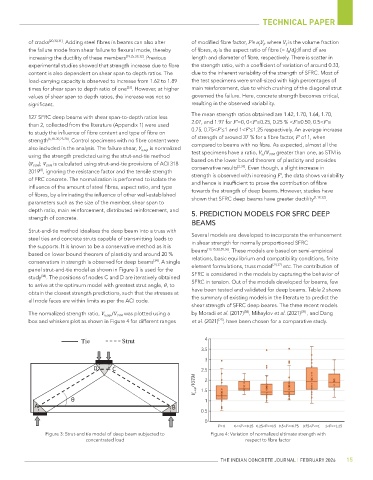
                                                                  The mean strength ratios obtained are 1.42, 1.70, 1.64, 1.70,
           127 SFRC deep beams with shear span-to-depth ratios less
           than 2, collected from the literature (Appendix 1) were used   2.07, and 1.97 for F’=0, 0<F’≤0.25, 0.25 % <F’≤0.50, 0.5<F’≤
           to study the influence of fibre content and type of fibre on   0.75, 0.75<F’≤1 and 1<F’≤1.25 respectively. An average increase
           strength [6,18-20,23-28] . Control specimens with no fibre content were   of strength of around 37 % for a fibre factor, F’ of 1, when
           also included in the analysis. The failure shear, V u,exp  is normalized   compared to beams with no fibre. As expected, almost all the
           using the strength predicted using the strut-and-tie method   test specimens have a ratio, V u /V STM  greater than one, as STM is
           (V STM ); V STM  is calculated using strut-and-tie provisions of ACI 318   based on the lower bound theorem of plasticity and provides
                                                                                 [2,34]
              [8]
           2019 , ignoring the resistance factor and the tensile strength   conservative results  . Even though, a slight increase in
                                                                  strength is observed with increasing F’, the data shows variability
           of FRC concrete. The normalization is performed to isolate the   and hence is insufficient to prove the contribution of fibre
           influence of the amount of steel fibres, aspect ratio, and type   towards the strength of deep beams. However, studies have
           of fibres, by eliminating the influence of other well-established                               [1,19,32]
           parameters such as the size of the member, shear span to   shown that SFRC deep beams have greater ductility  .
           depth ratio, main reinforcement, distributed reinforcement, and   5. PREDICTION MODELS FOR SFRC DEEP
           strength of concrete.
                                                                  BEAMS
           Strut-and-tie method idealises the deep beam into a truss with
           steel ties and concrete struts capable of transmitting loads to   Several models are developed to incorporate the enhancement
           the supports. It is known to be a conservative method as it is   in shear strength for normally proportioned SFRC
                                                                       [13,15,32,35,36]
           based on lower bound theorem of plasticity and around 20 %   beams  . These models are based on semi-empirical
                                                     [34]
           conservatism in strength is observed for deep beams . A single   relations, basic equilibrium and compatibility conditions, finite
                                                                                             [24,37]
           panel strut-and-tie model as shown in Figure 3 is used for the   element formulations, truss model   etc. The contribution of
           study . The positions of nodes C and D are iteratively obtained   SFRC is considered in the models by capturing the behavior of
               [34]
           to arrive at the optimum model with greatest strut angle, θ, to   SFRC in tension. Out of the models developed for beams, few
           obtain the closest strength predictions, such that the stresses at   have been tested and validated for deep beams. Table 2 shows
           all node faces are within limits as per the ACI code.   the summary of existing models in the literature to predict the
                                                                  shear strength of SFRC deep beams. The three recent models
                                                                                   [38]
           The normalized strength ratio, V u,exp /V STM  was plotted using a   by Moradi et al. (2017) , Mihaylov et al. (2021) [39]  , and Dang
           box and whiskers plot as shown in Figure 4 for different ranges   et al. (2021) , have been chosen for a comparative study.
                                                                           [25]

                            Tie           Strut                       4
                                                                     3.5
                                                                      3
                                 D     C                             2.5
                                                                   /VSTM  2

                                                                   V u, exp  1.5
                                                                      1
             A                                             B
                                                                     0.5
                                                                      0
                                                                                          F’
                                                                          F’= 0  0<=F’<=0.25 0.25< <=0.5 0.5<F’<=0.75  0.75<F’<=1  1< <=1.25
                                                                                                                F’
                Figure 3: Strut-and tie model of deep beam subjected to   Figure 4: Variation of normalized ultimate strength with
                              concentrated load                                     respect to fibre factor
                                                                           THE INDIAN CONCRETE JOURNAL | FEBRUARY 2026  15

