


Page 5 - ICJ Feb Openaccess 2026
P. 5
TECHNICAL PAPER


                                    P                             3.  FRACTURE OF FIBRE REINFORCED
                                                                  CONCRETE AS BASIS FOR TOUGHNESS AND
                                                                  DESIGN
                                                           d

                                           a                      Toughness based on the load-deflection
                                                                  response of unnotched beams

                                   e                              Failure in fibre reinforced concrete (FRC), especially in common
                                2.5                               applications with low fibre volume fractions (i.e., less than 1 %),
                                                                  occur with the development of one or few major cracks, which
                              3.125
                                                                  propagate in a stable manner. This justifies the need for fracture
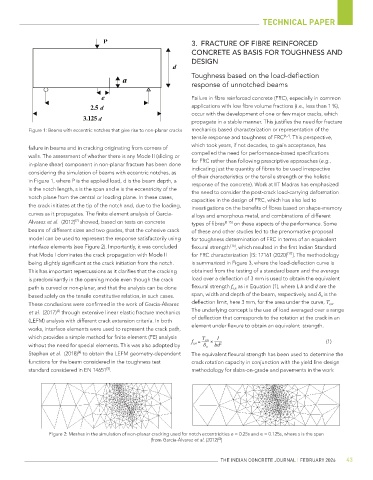
           Figure 1: Beams with eccentric notches that give rise to non-planar cracks  mechanics based characterization or representation of the
                                                                  tensile response and toughness of FRC [6,7] . This perspective,
                                                                  which took years, if not decades, to gain acceptance, has
           failure in beams and in cracking originating from corners of
                                                                  compelled the need for performance-based specifications
           walls. The assessment of whether there is any Mode II (sliding or
                                                                  for FRC rather than following prescriptive approaches (e.g.,
           in-plane shear) component in non-planar fracture has been done
           considering the simulation of beams with eccentric notches, as   indicating just the quantity of fibres to be used irrespective
                                                                  of their characteristics or the tensile strength or the holistic
           in Figure 1, where P is the applied load, d is the beam depth, a   response of the concrete). Work at IIT Madras has emphasized
           is the notch length, s is the span and e is the eccentricity of the   the need to consider the post-crack load-carrying deformation
           notch plane from the central or loading plane. In these cases,
                                                                  capacities in the design of FRC, which has also led to
           the crack initiates at the tip of the notch and, due to the loading,   investigations on the benefits of fibres based on shape-memory
           curves as it propagates. The finite element analysis of García-  alloys and amorphous metal, and combinations of different
                          [2]
           Álvarez et al.  (2012)  showed, based on tests on concrete   types of fibres [8-15]  on these aspects of the performance. Some
           beams of different sizes and two grades, that the cohesive crack   of these and other studies led to the prenormative proposal
           model can be used to represent the response satisfactorily using   for toughness determination of FRC in terms of an equivalent
           interface elements (see Figure 2). Importantly, it was concluded   flexural strength  [16] , which resulted in the first Indian Standard
           that Mode I dominates the crack propagation with Mode II   for FRC characterization [IS: 17161 (2020) ]. The methodology
                                                                                                  [17]
           being slightly significant at the crack initiation from the notch.   is summarized in Figure 3, where the load-deflection curve is
           This has important repercussions as it clarifies that the cracking   obtained from the testing of a standard beam and the average
           is predominantly in the opening mode even though the crack   load over a deflection of 3 mm is used to obtain the equivalent
           path is curved or non-planar, and that the analysis can be done   flexural strength f e,n  as in Equation (1), where l, b and d are the
           based solely on the tensile constitutive relation, in such cases.   span, width and depth of the beam, respectively, and δ n  is the
           These conclusions were confirmed in the work of García-Álvarez   deflection limit, here 3 mm, for the area under the curve, T e,n .
           et al.  (2017)  through extensive linear elastic fracture mechanics   The underlying concept is the use of load averaged over a range
                    [3]
                                                                  of deflection that corresponds to the rotation at the crack in an
           (LEFM) analysis with different crack extension criteria. In both
                                                                  element under flexure to obtain an equivalent  strength.
           works, interface elements were used to represent the crack path,
           which provides a simple method for finite element (FE) analysis   T e,n  l
                                                                  f e,n  =    ×   2                            (1)
           without the need for special elements. This was also adopted by   δ n  bd
           Stephen et al.  (2018)  to obtain the LEFM geometry-dependent   The equivalent flexural strength has been used to determine the
                           [4]
           functions for the beam considered in the toughness test   crack rotation capacity in conjunction with the yield line design
           standard considered in EN 14651 .                      methodology for slabs-on-grade and pavements in the work
                                     [5]


                  Figure 2: Meshes in the simulation of non-planar cracking used for notch eccentricities e = 0.25s and e = 0.125s, where s is the span
                                                    [from García-Álvarez et al. (2012) ]
                                                                           [2]

                                                                           THE INDIAN CONCRETE JOURNAL | FEBRUARY 2026  43

