


Page 7 - ICJ Feb Openaccess 2026
P. 7
TECHNICAL PAPER


           Inverse analysis for the tensile constitutive
           relation of concrete

           A more important output of the fracture research at IIT Madras
           was the development of a robust inverse analysis procedure for
           obtaining the tensile stress-crack width (σ-w) relation from the
           load-CMOD curve of a notched beam. This follows the approach
                          [32]
           of Sousa and Gettu , which was formulated on the basis of a
           rotating hinge model at the crack plane (see also Sousa et al.
               [33]
                                     [34]
           (2018) , and RILEM TC 187-SOC ). This was extended, in the
           work of Stephen et al.  (2007)  to the commonly used EN 14651
                                  [35]
           geometry by developing closed-form solutions and an open
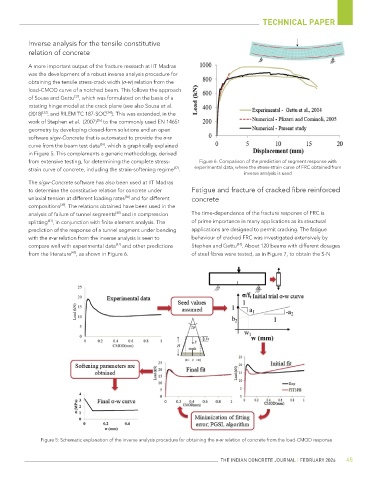
           software sigw-Concrete that is automated to provide the σ-w
           curve from the beam test data , which is graphically explained
                                   [36]
           in Figure 5. This complements a generic methodology, derived
           from extensive testing, for determining the complete stress-  Figure 6: Comparison of the prediction of segment response with
                                                            [37]
           strain curve of concrete, including the strain-softening regime .   experimental data, where the stress-strain curve of FRC obtained from
                                                                                   inverse analysis is used
           The sigw-Concrete software has also been used at IIT Madras
           to determine the constitutive relation for concrete under   Fatigue and fracture of cracked fibre reinforced
           uniaxial tension at different loading rates  and for different   concrete
                                           [38]
                     [39]
           compositions . The relations obtained have been used in the
                                        [40]
           analysis of failure of tunnel segments  and in compression   The time-dependence of the fracture response of FRC is
                 [41]
           splitting , in conjunction with finite element analysis. The   of prime importance in many applications as its structural
           prediction of the response of a tunnel segment under bending   applications are designed to permit cracking. The fatigue
           with the σ-w relation from the inverse analysis is seen to   behaviour of cracked FRC was investigated extensively by
                                                                                 [44]
           compare well with experimental data  and other predictions   Stephen and Gettu . About 120 beams with different dosages
                                        [42]
                         [43]
           from the literature , as shown in Figure 6.            of steel fibres were tested, as in Figure 7, to obtain the S-N


               Figure 5: Schematic explanation of the inverse analysis procedure for obtaining the σ-w relation of concrete from the load-CMOD response


                                                                           THE INDIAN CONCRETE JOURNAL | FEBRUARY 2026  45

