


Page 9 - ICJ Feb Openaccess 2026
P. 9
TECHNICAL PAPER


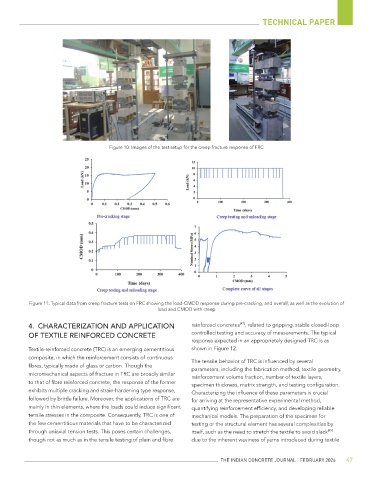
                                      Figure 10: Images of the test setup for the creep fracture response of FRC


           Figure 11: Typical data from creep fracture tests on FRC showing the load-CMOD response during pre-cracking, and overall, as well as the evolution of
                                                      load and CMOD with creep


                                                                                  [47]
           4.  CHARACTERIZATION AND APPLICATION                   reinforced concretes , related to gripping, stable closed-loop
                                                                  controlled testing and accuracy of measurements. The typical
           OF TEXTILE REINFORCED CONCRETE
                                                                  response expected in an appropriately designed TRC is as
           Textile-reinforced concrete (TRC) is an emerging cementitious   shown in Figure 12.
           composite, in which the reinforcement consists of continuous
                                                                  The tensile behavior of TRC is influenced by several
           fibres, typically made of glass or carbon. Though the
                                                                  parameters, including the fabrication method, textile geometry,
           micromechanical aspects of fracture in TRC are broadly similar
                                                                  reinforcement volume fraction, number of textile layers,
           to that of fibre reinforced concrete, the response of the former   specimen thickness, matrix strength, and testing configuration.
           exhibits multiple cracking and strain-hardening type response,   Characterizing the influence of these parameters is crucial
           followed by brittle failure. Moreover, the applications of TRC are   for arriving at the representative experimental method,
           mainly in thin elements, where the loads could induce significant   quantifying reinforcement efficiency, and developing reliable
           tensile stresses in the composite. Consequently, TRC is one of   mechanical models. The preparation of the specimen for
           the few cementitious materials that have to be characterized   testing or the structural element has several complexities by
                                                                                                                [49]
           through uniaxial tension tests. This poses certain challenges,   itself, such as the need to stretch the textile to avoid slack
           though not as much as in the tensile testing of plain and fibre   due to the inherent waviness of yarns introduced during textile


                                                                           THE INDIAN CONCRETE JOURNAL | FEBRUARY 2026  47

