


Page 10 - ICJ Feb Openaccess 2026
P. 10
TECHNICAL PAPER


                                              Stage I: Initial response
                                            dominated by the matrix.
                                            State II: Multiple cracking of
                                            the matrix
                                            State III: Cracks open.
                                            Load carried by the textile
                                            filaments until  rupture


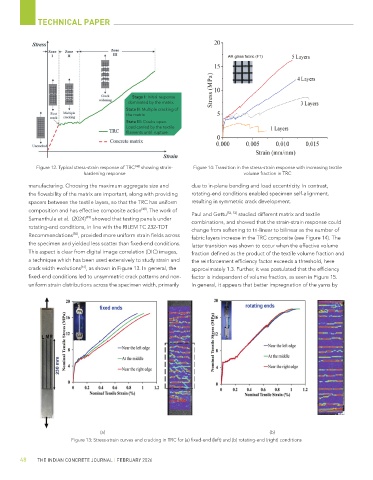
             Figure 12. Typical stress-strain response of TRC  [48]  showing strain-  Figure 14: Transition in the stress-strain response with increasing textile
                             hardening response                                    volume fraction in TRC
           manufacturing. Choosing the maximum aggregate size and   due to in-plane bending and load eccentricity. In contrast,
           the flowability of the matrix are important, along with providing   rotating-end conditions enabled specimen self-alignment,
           spacers between the textile layers, so that the TRC has uniform   resulting in symmetric crack development.
           composition and has effective composite action . The work of   Paul and Gettu [52, 53]  studied different matrix and textile
                                                 [48]
           Samanthula et al.  (2024)  showed that testing panels under   combinations, and showed that the strain-strain response could
                              [49]
           rotating-end conditions, in line with the RILEM TC 232-TDT
                                                                  change from softening to tri-linear to bilinear as the number of
           Recommendations , provided more uniform strain fields across
                          [50]
                                                                  fabric layers increase in the TRC composite (see Figure 14). The
           the specimen and yielded less scatter than fixed-end conditions.   latter transition was shown to occur when the effective volume
           This aspect is clear from digital image correlation (DIC) images,   fraction defined as the product of the textile volume fraction and
           a technique which has been used extensively to study strain and   the reinforcement efficiency factor exceeds a threshold, here
                            [51]
           crack width evolutions , as shown in Figure 13. In general, the   approximately 1.3. Further, it was postulated that the efficiency
           fixed-end conditions led to unsymmetric crack patterns and non-  factor is independent of volume fraction, as seen in Figure 15.
           uniform strain distributions across the specimen width, primarily   In general, it appears that better impregnation of the yarns by


                                   (a)                                                      (b)
                         Figure 13: Stress-strain curves and cracking in TRC for (a) fixed-end (left) and (b) rotating-end (right) conditions


        48    THE INDIAN CONCRETE JOURNAL | FEBRUARY 2026

