


Page 6 - ICJ Feb Openaccess 2026
P. 6
TECHNICAL PAPER


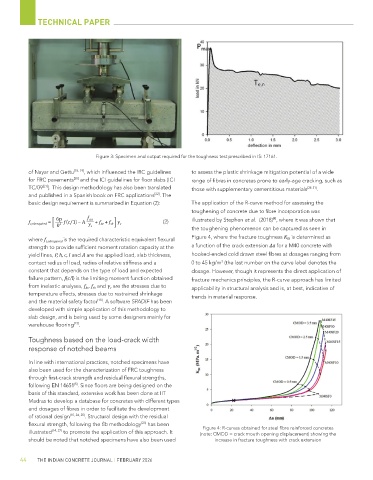
                                 Figure 3: Specimen and output required for the toughness test prescribed in IS: 17161.


           of Nayar and Gettu [18, 19] , which influenced the IRC guidelines   to assess the plastic shrinkage mitigation potential of a wide
                          [20]
           for FRC pavements  and the ICI guidelines for floor slabs (ICI   range of fibres in concretes prone to early-age cracking, such as
               [21]
           TC/09 ). This design methodology has also been translated   those with supplementary cementitious materials [28-31] .
                                                     [22]
           and published in a Spanish book on FRC applications . The
           basic design requirement is summarized in Equation (2):  The application of the R-curve method for assessing the
                                                                  toughening of concrete due to fibre incorporation was
                                                                                             [4]
                    6p        f ctk                               illustrated by Stephen et al.  (2018) , where it was shown that
           f e,nkrequired  = �   2   f (c/1) – A    + f Δt  + f sh  � γ c     (2)
                    h          γ c
                                                                  the toughening phenomenon can be captured as seen in
           where f e,nkrequired  is the required characteristic equivalent flexural   Figure 4, where the fracture toughness K IR  is determined as
           strength to provide sufficient moment rotation capacity at the   a function of the crack extension Δa for a M40 concrete with
           yield lines, P, h, c, l and A are the applied load, slab thickness,   hooked-ended cold drawn steel fibres at dosages ranging from
           contact radius of load, radius of relative stiffness and a    0 to 45 kg/m  (the last number on the curve label denotes the
                                                                            3
           constant that depends on the type of load and expected   dosage. However, though it represents the direct application of
           failure pattern, f(c/l) is the limiting moment function obtained   fracture mechanics principles, the R-curve approach has limited
           from inelastic analyses, f Δt , f sh  and γ c  are the stresses due to   applicability in structural analysis and is, at best, indicative of
           temperature effects, stresses due to restrained shrinkage   trends in material response.
                                  [18]
           and the material safety factor . A software SPADIF has been
           developed with simple application of this methodology to
           slab design, and is being used by some designers mainly for
                          [23]
           warehouse flooring .
           Toughness based on the load-crack width
           response of notched beams


           In line with international practices, notched specimens have
           also been used for the characterization of FRC toughness
           through first-crack strength and residual flexural strengths,
                          [5]
           following EN 14651 . Since floors are being designed on the
           basis of this standard, extensive work has been done at IIT
           Madras to develop a database for concretes with different types
           and dosages of fibres in order to facilitate the development
           of rational design [15, 24, 25] . Structural design with the residual
           flexural strength, following the fib methodology  has been
                                                 [26]
                                                                     Figure 4: R-curves obtained for steel fibre reinforced concretes
           illustrated [14, 27]  to promote the application of this approach. It   (note: CMOD = crack mouth opening displacement) showing the
           should be noted that notched specimens have also been used    increase in fracture toughness with crack extension

        44    THE INDIAN CONCRETE JOURNAL | FEBRUARY 2026

