


Page 3 - Open-Access-September-2020
P. 3
TECHNICAL PAPER


                                                               P     Load spreader


                                         2 Ø  8                               2 legged Ø  6 @ 125 c/c
                                                           A

                               255                                                              175


                               45
                                         3 Ø  8  1 Ø  8   A'        2 legged Ø  6 @ 200 c/c

                                  100        600              600               600       100
                                                              2000
                                                        Longitudinal section
                                   Prestressing tendon  Non-prestressing tendon  Dimensions in mm
                                          200                   200                   200
                                                                                              40
                                                                        175
                                   300             255   300                   300


                                      Section A-A'          Section A-A'          Section A-A'
                                          (a)                   (b)                   (c)
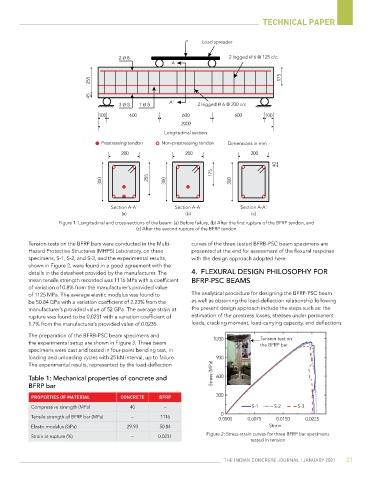
                     Figure 1: Longitudinal and cross-sections of the beam: (a) Before failure, (b) After the first rupture of the BFRP tendon, and
                                               (c) After the second rupture of the BFRP tendon

           Tension tests on the BFRP bars were conducted in the Multi-  curves of the three tested BFRB-PSC beam specimens are
           Hazard Protective Structures (MHPS) Laboratory, on three   presented at the end for assessment of the flexural response
           specimens, S-1, S-2, and S-3, and the experimental results,   with the design approach adopted here.
           shown in Figure 2, were found in a good agreement with the
           details in the datasheet provided by the manufacturer. The   4.  FLEXURAL DESIGN PHILOSOPHY FOR
           mean tensile strength recorded was 1116 MPa with a coefficient   BFRP-PSC BEAMS
           of variation of 0.8% from the manufacturer’s provided value
           of 1125 MPa. The average elastic modulus was found to   The analytical procedure for designing the BFRP-PSC beam
           be 50.84 GPa with a variation coefficient of 2.23% from the   as well as obtaining the load-deflection relationship following
           manufacturer’s provided value of 52 GPa. The average strain at   the present design approach include the steps such as: the
           rupture was found to be 0.0231 with a variation coefficient of   estimation of the prestress losses, stresses under permanent
           1.7% from the manufacturer’s provided value of 0.0235.  loads, cracking moment, load-carrying capacity, and deflections
           The preparation of the BFRB-PSC beam specimens and                            Tension test on
           the experimental setup are shown in Figure 3. Three beam      1200            the BFRP bar
           specimens were cast and tested in four-point bending test, in
           loading and unloading cycles with 25 kN interval, up to failure.   900
           The experimental results, represented by the load-deflection

           Table 1: Mechanical properties of concrete and                Stress (MPa)  600
           BFRP bar
            PROPERTIES OF MATERIAL        CONCRETE     BFRP               300
            Compressive strength (MPa)       40         –                             S-1    S-2     S-3
                                                                                      S-1
                                                                            0
            Tensile strength of BFRP bar (MPa)  –      1116                0.0000    0.0075   0.0150    0.0225
            Elastic modulus (GPa)           29.93      50.84                                Strain
            Strain at rupture (%)            –        0.0231           Figure 2: Stress-strain curves for three BFRP bar specimens
                                                                                     tested in tension


                                                                            THE INDIAN CONCRETE JOURNAL | JANUARY 2021  21

