


Page 5 - Open-Access-September-2020
P. 5
TECHNICAL PAPER


           Table 2: Flexural analysis results of the BFRP-PSC
           beam compared to the experimental findings
                    STAGE            PRE-    POST-     POST-
                                   FAILURE   FIRST    SECOND
                                            RUPTURE   RUPTURE
                Balanced ratio, 'ρ b '  0.0053  0.0053  0.0027
              Reinforcement ratio, 'ρ'  0.0026  0.0024  0.002
             Depth of neutral axis (mm)  30.5  26.0     21.7
           Load-carrying   Present   114.1    94.6      92.3
            capacity (kN)  approach
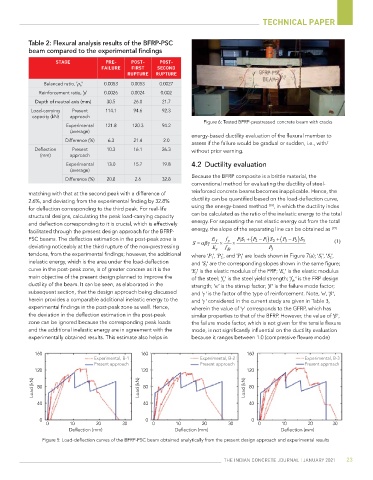
                                                                      Figure 6: Tested BFRP-prestressed concrete beam with cracks
                       Experimental   121.8   120.3     94.2
                         (average)
                                                                  energy-based ductility evaluation of the flexural member to
                       Difference (%)  6.3    21.4      2.0
                                                                  assess if the failure would be gradual or sudden, i.e., with/
             Deflection   Present    10.3     16.1      26.3      without prior warning.
               (mm)      approach
                       Experimental   13.0    15.7      19.8      4.2  Ductility evaluation
                         (average)
                                                                  Because the BFRP composite is a brittle material, the
                       Difference (%)  20.8    2.6      32.8
                                                                  conventional method for evaluating the ductility of steel-
           matching with that at the second peak with a difference of   reinforced concrete beams becomes inapplicable. Hence, the
           2.6%, and deviating from the experimental finding by 32.8%   ductility can be quantified based on the load-deflection curve,
                                                                                            [19]
           for deflection corresponding to the third peak. For real-life   using the energy-based method  , in which the ductility index
           structural designs, calculating the peak load-carrying capacity   can be calculated as the ratio of the inelastic energy to the total
           and deflection corresponding to it is crucial, which is effectively   energy. For separating the net elastic energy out from the total
           facilitated through the present design approach for the BFRP-  energy, the slope of the separating line can be obtained as  [19]
           PSC beams. The deflection estimation in the post-peak zone is   S        E f     f y     PS     P     22  P S    3  PS  (1)
                                                                                                P     3
                                                                                                    2
                                                                                  11
                                                                                          1
           deviating noticeably at the third rupture of the non-prestressing   E s  f ds    P 3
           tendons, from the experimental findings; however, the additional   where 'P 1 ', 'P 2 ', and 'P 3 ' are loads shown in Figure 7(a); 'S 1 ', 'S 2 ',
           inelastic energy, which is the area under the load-deflection   and 'S 3 ' are the corresponding slopes shown in the same figure;
           curve in the post-peak zone, is of greater concern as it is the   'E f  ' is the elastic modulus of the FRP; 'E s  ' is the elastic modulus
           main objective of the present design planned to improve the   of the steel; 'f y  ' is the steel yield strength; 'f ds  ' is the FRP design
           ductility of the beam. It can be seen, as elaborated in the   strength; 'α   ' is the stirrup factor; 'β' is the failure mode factor;

           subsequent section, that the design approach being discussed   and 'γ   ' is the factor of the type of reinforcement. Note, 'α', 'β',

           herein provides a comparable additional inelastic energy to the   and 'γ   ' considered in the current study are given in Table 3,
           experimental findings in the post-peak zone as well. Hence,   wherein the value of 'γ   ' corresponds to the GFRP, which has
           the deviation in the deflection estimation in the post-peak   similar properties to that of the BFRP. However, the value of 'β',

           zone can be ignored because the corresponding peak loads   the failure mode factor, which is not given for the tensile flexure
           and the additional inelastic energy are in agreement with the   mode, is not significantly influential on the ductility evaluation
           experimentally obtained results. This estimate also helps in   because it ranges between 1.0 (compressive flexure mode)


             160                                160                                 160
                                 Experimental, B-1                  Experimental, B-2                   Experimental, B-3
                                 Present approach                   Present approach                    Present approach
             120                                120                                 120
            Load (kN)  80                       Load (kN)  80                       Load (kN)  80


              40                                 40                                  40


              0                                   0                                   0
                 0       10      20       30        0       10       20       30        0       10       20      30
                        Deflection (mm)                      Deflection (mm)                      Deflection (mm)
               Figure 5: Load-deflection curves of the BFRP-PSC beam obtained analytically from the present design approach and experimental results


                                                                            THE INDIAN CONCRETE JOURNAL | JANUARY 2021  23

