


Page 6 - Open-Access-September-2020
P. 6
TECHNICAL PAPER


                                            Grace et al.  (1998) [19]
                                                                                             Present approach
                                                                120  P 2
                     P 3
                     P 2
                                 S 3
                          S 1
                                                                        S 2
                               S 2                               80
                      Load                                      Load (kN)  P 1
                                Inelastic  S
                     P 1        energy                                  E in  S
                                ()
                                E in
                                                                 40                Additional inelastic
                                          Elastic energy
                                               )                     S 1               energy
                                             (E esc
                                                                              E esc    [E in addl(  ] )
                                                                  0
                                                                    0          10          20          30
                                      Deflection                                  Deflection (mm)
                                         (a)                                          (b)
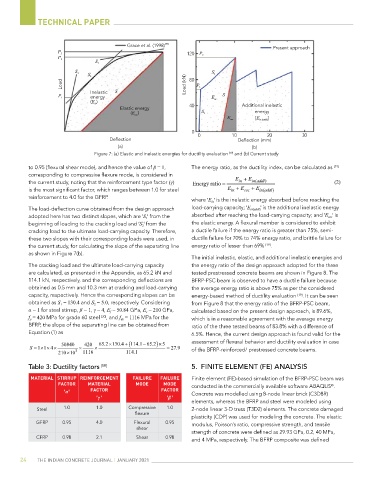
                                 Figure 7: (a) Elastic and inelastic energies for ductility evaluation  [19]  and (b) Current study
           to 0.95 (flexural shear mode), and hence the value of β = 1,   The energy ratio, as the ductility index, can be calculated as  [19]
           corresponding to compressive flexure mode, is considered in
           the current study, noting that the reinforcement type factor (γ)   Energy ratio    E in    E in (addl )  (2)
           is the most significant factor, which ranges between 1.0 for steel   E in    E esc    E in (addl )
           reinforcement to 4.0 for the GFRP.
                                                                  where 'E in ' is the inelastic energy absorbed before reaching the
           The load-deflection curve obtained from the design approach   load-carrying capacity; 'E in(addl) ' is the additional inelastic energy
           adopted here has two distinct slopes, which are 'S 1 ' from the   absorbed after reaching the load-carrying capacity; and 'E esc ' is
           beginning of loading to the cracking load and 'S 2 ' from the   the elastic energy. A flexural member is considered to exhibit
           cracking load to the ultimate load-carrying capacity. Therefore,   a ductile failure if the energy ratio is greater than 75%, semi-
           these two slopes with their corresponding loads were used, in   ductile failure for 70% to 74% energy ratio, and brittle failure for
           the current study, for calculating the slope of the separating line   energy ratio of lesser than 69%  .
                                                                                           [19]
           as shown in Figure 7(b).
                                                                  The initial inelastic, elastic, and additional inelastic energies and
           The cracking load and the ultimate load-carrying capacity   the energy ratio of the design approach adopted for the three
           are calculated, as presented in the Appendix, as 65.2 kN and   tested prestressed concrete beams are shown in Figure 8. The
           114.1 kN, respectively, and the corresponding deflections are   BFRP-PSC beam is observed to have a ductile failure because
           obtained as 0.5 mm and 10.3 mm at cracking and load-carrying   the average energy ratio is above 75% as per the considered
           capacity, respectively. Hence the corresponding slopes can be   energy-based method of ductility evaluation  . It can be seen
                                                                                                     [19]
           obtained as S 1  = 130.4 and S 2  = 5.0, respectively. Considering   from Figure 8 that the energy ratio of the BFRP-PSC beam,

           α = 1 for steel stirrup, β = 1, γ = 4, E f  = 50.84 GPa, E s  = 210 GPa,   calculated based on the present design approach, is 89.6%,

           f y  = 420 MPa for grade 60 steel  , and f ds  = 1116 MPa for the   which is in a reasonable agreement with the average energy
                                   [20]

           BFRP, the slope of the separating line can be obtained from   ratio of the three tested beams of 83.8% with a difference of
           Equation (1) as                                        6.5%. Hence, the current design approach is found valid for the
                                    .
           S          50840     420     65 2   130 4.     114 1652.     .     5     27 9  assessment of flexural behavior and ductility evaluation in case
                                                            .
              11 4
                                                                  of the BFRP-reinforced/ prestressed concrete beams.
                     210  10 3  1116       114.1 1
           Table 3: Ductility factors  [19]                       5.  FINITE ELEMENT (FE) ANALYSIS
           MATERIAL STIRRUP  REINFORCEMENT    FAILURE    FAILURE   Finite element (FE)-based simulation of the BFRP-PSC beam was
                     FACTOR    MATERIAL        MODE     MODE      conducted in the commercially available software ABAQUS .
                                                                                                                 ®
                       'α'      FACTOR                 FACTOR     Concrete was modelled using 8-node linear brick (C3D8R)
                                 'γ   '                  'β'
                                                                  elements, whereas the BFRP and steel were modeled using
             Steel     1.0       1.0        Compressive   1.0     2-node linear 3-D truss (T3D2) elements. The concrete damaged
                                               flexure
                                                                  plasticity (CDP) was used for modeling the concrete. The elastic
             GFRP     0.95       4.0          Flexural   0.95     modulus, Poisson’s ratio, compressive strength, and tensile
                                               shear
                                                                  strength of concrete were defined as 29.93 GPa, 0.2, 40 MPa,
             CFRP     0.98       2.1           Shear     0.98
                                                                  and 4 MPa, respectively. The BFRP composite was defined

        24    THE INDIAN CONCRETE JOURNAL | JANUARY 2021

