


Page 4 - Open-Access-September-2020
P. 4
TECHNICAL PAPER


                                           Reinforcement
                                               cage
                                                        Prestressing          Cast beam
                                                          bed

                                                         Wooden
                                                           mold


                                                   Load cell
                                                                                    Load spreader
                                                             600 mm
                                          600 mm                                 600 mm
                               300 mm


                                         Support pin                  LVDT
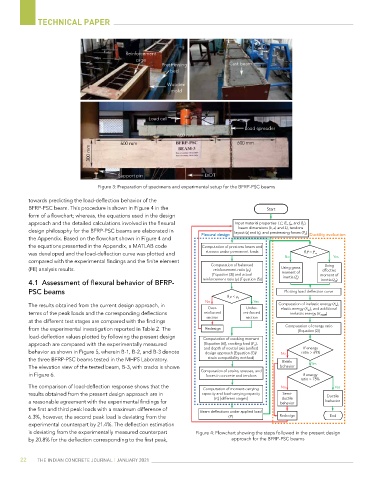
                                  Figure 3: Preparation of specimens and experimental setup for the BFRP-PSC beams

           towards predicting the load-deflection behavior of the
           BFRP-PSC beam. This procedure is shown in Figure 4 in the                       Start
           form of a flowchart; whereas, the equations used in the design
           approach and the detailed calculations involved in the flexural      Input material properties ( f c Ef and  f E  ),
                                                                                                  ,,
                                                                                                ',
                                                                                                  c
                                                                                                   fu
                                                                                                 L
                                                                                            bd
                                                                                 beam dimensions (, , and ), tendons
           design philosophy for the BFRP-PSC beams are elaborated in           layout ( and ), and prestressing forces (F pi )
                                                                                    d j
                                                                                        h j
           the Appendix. Based on the flowchart shown in Figure 4 and   Flexural desig n                 Ductility e valuation
           the equations presented in the Appendix, a MATLAB code    Computation of prestress losses  and
           was developed and the load-deflection curve was plotted and   stresses under permanent loads  If P >  P cr
                                                                                                 No                                             Yes
           compared with the experimental findings and the finite element
                                                                        Computation of balanced               Using
           (FE) analysis results.                                        reinforcement ratio ()  Using gross  effective
                                                                                    ρ b
                                                                         [Equation (3)] and actual  moment of  moment of
                                                                                                inertia ()
                                                                                 ρ
                                                                     reinforcement ratio () [Equation (5)]  I g  inertia ()
           4.1  Assessment of flexural behavior of BFRP-
                                                                                                                 I eff
           PSC beams                                                                             Plotting load-deflection curve
                                                                              If ρ  < ρ b
                                                                      No              Yes
           The results obtained from the current design approach, in                           Computation of inelastic energy (),
                                                                                                                 E in
                                                                       Over-        Under-      elastic energy (E esc ), and additional
           terms of the peak loads and the corresponding deflections   reinforced  reinforced      inelastic energy (E in addl(  ) )
                                                                       section      section
           at the different test stages are compared with the findings
                                                                                                 Computation of energy ratio
           from the experimental investigation reported in Table 2. The   Redesign                    [Equation (2)]
           load-deflection values plotted by following the present design
                                                                      Computation of cracking moment
           approach are compared with the experimentally measured     [Equation (6)], cracking load (P cr ),
                                                                      and depth of neutral axis (unified  If energy
           behavior as shown in Figure 5, wherein B-1, B-2, and B-3 denote   design approach [Equation (7)]/  No  ratio > 69%
           the three BFRP-PSC beams tested in the MHPS Laboratory.     strain compatibility method)  Brittle
           The elevation view of the tested beam, B-3, with cracks is shown                    behavior   Yes
                                                                     Computation of strains, stresses, and
           in Figure 6.                                               forces in concrete and tendons   If energy
                                                                                                      ratio > 75%
           The comparison of load-deflection response shows that the                            No                Yes
                                                                      Computation of moment-carrying
           results obtained from the present design approach are in   capacity and load-carrying capacity  Semi-  Ductile
                                                                                                ductile
           a reasonable agreement with the experimental findings for     () [different stages]  behavior       behavior
                                                                          P n
           the first and third peak loads with a maximum difference of   Beam deflections under applied load
           6.3%, however, the second peak load is deviating from the          ()               Redesign         End
                                                                              P
           experimental counterpart by 21.4%. The deflection estimation
           is deviating from the experimentally measured counterpart   Figure 4: Flowchart showing the steps followed in the present design
           by 20.8% for the deflection corresponding to the first peak,        approach for the BFRP-PSC beams
        22    THE INDIAN CONCRETE JOURNAL | JANUARY 2021

