


Page 5 - ICJ Jan 2026
P. 5
TECHNICAL PAPER


                                           [1].
           of dissolved phases and reaction kinetics  The hydrated cement   dosage, cluster II starts to disturb the effective w/c available for
           phases precipitate on available surfaces, in a phenomenon   hydration, reducing the observed strength improvement . At
                                                                                                              [1]
           known as nucleation. Nucleation over a surface hinders its   higher dosage, group I (silicate) and group II (alumina silicate)
                                                           [1]
           dissolution and acts as a limiter to the first stage of hydration .   exhibit better sustainability without negatively affecting the
                                               2+
           SCMs with higher specific surface area and Ca  content tend   strength . Furthermore, group I (silicates) are recommended
                                                                        [1]
           to attract precipitating phases and reduce nucleation over   in concrete with higher portlandite availability, like C 3 S cement
           unreacted cement phases .                              composite, as they can produce more pozzolanic reactions .
                               [1]
                                                                                                                [1]
                                                                  Higher concentration of soluble aluminium in alumina silicate,
           2.1  Characterisation-based assessment
                                                                  calcareous alumina silicate and slag can limit the solubility of
           Higher clinker substitution through SCM has always been   silicates and overall pozzolanic activity . Group II (alumina
                                                                                                [1]
                                         [2]
           advocated for improved sustainability . However, an extensive   silicates) are recommended for concrete with lower portlandite
           review of the legal framework, availability of raw materials and   availability, like C 2 S cement composite, for achieving high clinker
           consumption patterns revealed a major challenge associated   substitution .
                                                                           [1]
           with the selection of SCM and optimisation of its dosage [1,2] .
           It is important to note that higher clinker substitution is   Key contribution: The results clearly demonstrate that SCMs
           permitted within the legal framework, but requires additional   with similar specific surface area and elemental composition
           testing for material safety, which increases the project cost .   can be grouped together irrespective of their nature of origin.
                                                         [2]
           The stakeholders further face the challenge of different types   The study, for the first time, demonstrated the application of
           of SCMs with disproportionate geographic availability .   grouping across materials from different sources of origin. The
                                                     [1]
           Furthermore, most available literature classifies SCMs based   classification helps in optimising the use of new and alternative
           on the source of their origin. Several studies show that SCMs   materials as SCMs, based on the desired concrete application.
           from a similar source can perform significantly differently in
           concrete, limiting the replicability of results and stakeholder   Limitations: Assumptions were taken to account for the limited
                   [1]
           confidence . As an alternative strategy, the article advocates   reporting of characterisation data. In the case of limited
           for a characterisation-based assessment approach to select and   reporting, it has been assumed that the missing properties of
           optimise the dosage of SCMs in concrete.               any given SCM will be within the range reported across other
                                                                  reported studies on the same material. Due to the assumption,
           In one of the previous studies, an extensive meta-analysis   the study fails to establish a correlation between material
           was carried out to correlate the physical, chemical, and
           microstructural characteristics of SCMs with their effect on the   characteristics and the relative performance of different SCMs
                            [1]
           properties of concrete . The study showed that specific surface   within the same group of materials. Furthermore, the effect
           area and elemental composition have a strong correlation with   of amorphous content, electrical conductivity, pH and carbon
           mechanical, rheological and durability properties of concrete as   content was reported for very limited SCMs. Further inclusion
           compared to specific gravity, mineral composition and chemical   of these parameters may improve the characterisation-based
                     [1]
           composition . The particle morphology affects the rheological   classification.
           properties of fresh concrete, but does not correlate with other
                   [1]
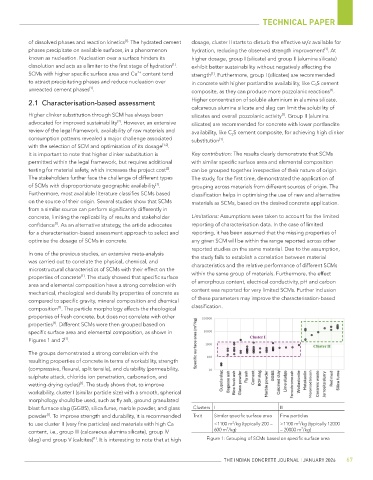
           properties . Different SCMs were then grouped based on
           specific surface area and elemental composition, as shown in
           Figures 1 and 2 .
                       [1]
           The groups demonstrated a strong correlation with the
           resulting properties of concrete in terms of workability, strength
           (compressive, flexural, split tensile), and durability (permeability,
           sulphate attack, chloride ion penetration, carbonation, and
                            [1]
           wetting-drying cycles) . The study shows that, to improve
           workability, cluster I (similar particle size) with a smooth, spherical
           morphology should be used, such as fly ash, ground granulated
           blast furnace slag (GGBS), silica fume, marble powder, and glass   Clusters I       II
                 [1]
           powder . To improve strength and durability, it is recommended   Trait  Similar specific surface area  Fine particles
                                                                               2
                                                                                                      2
           to use cluster II (very fine particles) and materials with high Ca   <1100 m /kg (typically 200 –   >1100 m /kg (typically 12000
                                                                                                       2
                                                                              2
           content, i.e., group III (calcareous alumina silicate), group IV   600 m /kg)       – 20000 m /kg)
           (slag) and group V (calcites) . It is interesting to note that at high   Figure 1: Grouping of SCMs based on specific surface area
                                [1]
                                                                            THE INDIAN CONCRETE JOURNAL | JANUARY 2026  67

