


Page 8 - ICJ Jan 2026
P. 8
TECHNICAL PAPER


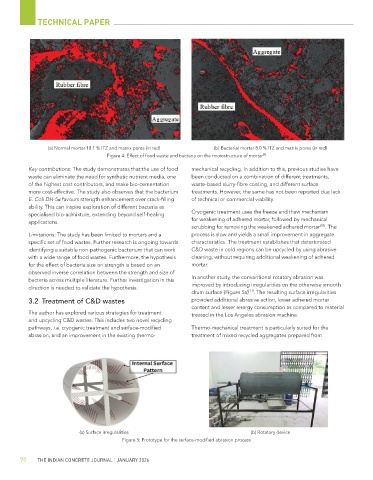
                 (a) Normal mortar 18.1 % ITZ and matrix pores (in red)   (b) Bacterial mortar 8.0 % ITZ and matrix pores (in red)
                                     Figure 4: Effect of food waste and bacteria on the microstructure of mortar [9]

           Key contributions: The study demonstrates that the use of food   mechanical recycling. In addition to this, previous studies have
           waste can eliminate the need for synthetic nutrient media, one   been conducted on a combination of different treatments,
           of the highest cost contributors, and make bio-cementation   waste-based slurry-fibre coating, and different surface
           more cost-effective. The study also observes that the bacterium   treatments. However, the same has not been reported due lack
           E. Coli DH-5α favours strength enhancement over crack-filling   of technical or commercial viability.
           ability. This can inspire exploration of different bacteria as
           specialised bio-admixture, extending beyond self-healing   Cryogenic treatment uses the freeze and thaw mechanism
           applications.                                          for weakening of adhered mortar, followed by mechanical
                                                                                                             [10]
                                                                  scrubbing for removing the weakened adhered mortar . The
           Limitations: The study has been limited to mortars and a   process is slow and yields a small improvement in aggregate
           specific set of food wastes. Further research is ongoing towards   characteristics. The treatment establishes that deteriorated
           identifying a suitable non-pathogenic bacterium that can work   C&D waste in cold regions can be upcycled by using abrasive
           with a wide range of food wastes. Furthermore, the hypothesis   cleaning, without requiring additional weakening of adhered
           for the effect of bacteria size on strength is based on an   mortar.
           observed inverse correlation between the strength and size of
           bacteria across multiple literature. Further investigation in this   In another study, the conventional rotatory abrasion was
           direction is needed to validate the hypothesis.        improved by introducing irregularities on the otherwise smooth
                                                                  drum surface (Figure 5a) . The resulting surface irregularities
                                                                                     [11]
           3.2  Treatment of C&D wastes                           provided additional abrasive action, lower adhered mortar
                                                                  content and lesser energy consumption as compared to material
           The author has explored various strategies for treatment   treated in the Los Angeles abrasion machine.
           and upcycling C&D wastes. This includes two novel recycling
           pathways, i.e. cryogenic treatment and surface-modified   Thermo-mechanical treatment is particularly suited for the
           abrasion, and an improvement in the existing thermo-   treatment of mixed recycled aggregates prepared from


                            (a) Surface irregularities                                (b) Rotatory device
                                          Figure 5: Prototype for the surface-modified abrasion process


        70    THE INDIAN CONCRETE JOURNAL | JANUARY 2026

