


Page 12 - ICJ Jan 2026
P. 12
TECHNICAL PAPER


                                                                  4.1.2  Internal factors

                                                                  Internal factors correspond to the constituents of cement
                                                                  paste and their interactions. Among them, several factors,
                                                                  like w/c ratio, aggregate content, aggregate, and admixtures,
                                                                  are well explained in the literature . One new observation is
                                                                                             [28]
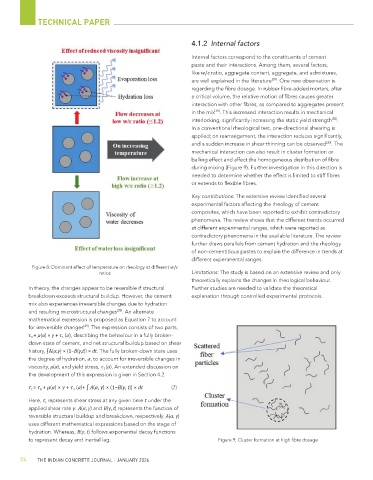
                                                                  regarding the fibre dosage. In rubber fibre-added mortars, after
                                                                  a critical volume, the relative motion of fibres causes greater
                                                                  interaction with other fibres, as compared to aggregates present
                                                                         [30]
                                                                  in the mix . This increased interaction results in mechanical
                                                                  interlocking, significantly increasing the static yield strength .
                                                                                                                 [30]
                                                                  In a conventional rheological test, one-directional shearing is
                                                                  applied; on rearrangement, the interaction reduces significantly,
                                                                  and a sudden increase in shear thinning can be observed . The
                                                                                                               [30]
                                                                  mechanical interaction can also result in cluster formation or
                                                                  balling effect and affect the homogeneous distribution of fibre
                                                                  during mixing (Figure 9). Further investigation in this direction is
                                                                  needed to determine whether the effect is limited to stiff fibres
                                                                  or extends to flexible fibres.

                                                                  Key contributions: The extensive review identified several
                                                                  experimental factors affecting the rheology of cement
                                                                  composites, which have been reported to exhibit contradictory
                                                                  phenomena. The review shows that the different trends occurred
                                                                  at different experimental ranges, which were reported as
                                                                  contradictory phenomena in the available literature. The review
                                                                  further draws parallels from cement hydration and the rheology
                                                                  of non-cementitious pastes to explain the difference in trends at
                                                                  different experimental ranges.
            Figure 8: Dominant effect of temperature on rheology at different w/c
                                  ratios                          Limitations: The study is based on an extensive review and only
                                                                  theoretically explains the changes in rheological behaviour.
           In theory, the changes appear to be reversible if structural   Further studies are needed to validate the theoretical
           breakdown exceeds structural buildup. However, the cement   explanation through controlled experimental protocols.
           mix also experiences irreversible changes due to hydration
                                         [28]
           and resulting microstructural changes . An alternate
           mathematical expression is proposed as Equation 7 to account
           for irreversible changes . The expression consists of two parts,
                             [29]
           τ 0  + μ(α) × γ + τ 1  (α), describing the behaviour in a fully broken-
           down state of cement, and net structural buildup based on shear
           history, ∫A(α,γ) × (1–B(γ,t)) × dt. The fully broken-down state uses
           the degree of hydration, α, to account for irreversible changes in
           viscosity, μ(α), and yield stress, τ 1  (α). An extended discussion on
           the development of this expression is given in Section 4.2.

           τ t  = τ 0  + μ(α) × γ + τ 1  (α)+ ∫ A(α, γ) × (1–B(γ, t)) × dt   (7)

           Here, τ t  represents shear stress at any given time t under the
           applied shear rate γ. A(α, γ) and B(γ, t) represents the function of
           reversible structural buildup and breakdown, respectively. A(α, γ)
           uses different mathematical expressions based on the stage of
           hydration. Whereas, B(γ, t) follows exponential decay functions
           to represent decay and inertial lag.                            Figure 9: Cluster formation at high fibre dosage


        74    THE INDIAN CONCRETE JOURNAL | JANUARY 2026

