


Page 14 - ICJ Jan 2026
P. 14
TECHNICAL PAPER


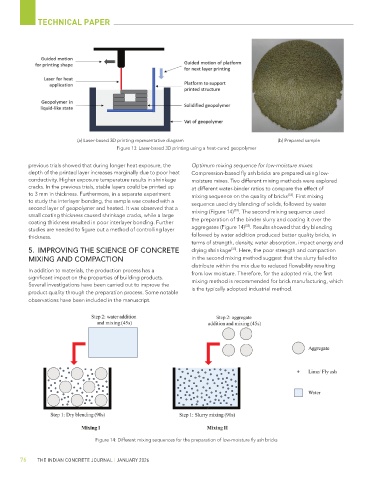
                           (a) Laser-based 3D printing representative diagram                  (b) Prepared sample
                                        Figure 13: Laser-based 3D printing using a heat-cured geopolymer

           previous trials showed that during longer heat exposure, the   Optimum mixing sequence for low-moisture mixes:
           depth of the printed layer increases marginally due to poor heat   Compression-based fly ash bricks are prepared using low-
           conductivity. Higher exposure temperature results in shrinkage   moisture mixes. Two different mixing methods were explored
           cracks. In the previous trials, stable layers could be printed up   at different water-binder ratios to compare the effect of
           to 3 mm in thickness. Furthermore, in a separate experiment   mixing sequence on the quality of bricks . First mixing
                                                                                                  [33]
           to study the interlayer bonding, the sample was coated with a   sequence used dry blending of solids, followed by water
           second layer of geopolymer and heated. It was observed that a   mixing (Figure 14) . The second mixing sequence used
                                                                                [33]
           small coating thickness caused shrinkage cracks, while a large
           coating thickness resulted in poor interlayer bonding. Further   the preparation of the binder slurry and coating it over the
                                                                                    [33]
           studies are needed to figure out a method of controlling layer   aggregates (Figure 14) . Results showed that dry blending
           thickness.                                             followed by water addition produced better quality bricks, in
                                                                  terms of strength, density, water absorption, impact energy and
                                                                               [33]
           5.  IMPROVING THE SCIENCE OF CONCRETE                  drying shrinkage . Here, the poor strength and compaction
           MIXING AND COMPACTION                                  in the second mixing method suggest that the slurry failed to
                                                                  distribute within the mix due to reduced flowability resulting
           In addition to materials, the production process has a   from low moisture. Therefore, for the adopted mix, the first
           significant impact on the properties of building products.   mixing method is recommended for brick manufacturing, which
           Several investigations have been carried out to improve the
           product quality through the preparation process. Some notable   is the typically adopted industrial method.
           observations have been included in the manuscript.


                                 Figure 14: Different mixing sequences for the preparation of low-moisture fly ash bricks


        76    THE INDIAN CONCRETE JOURNAL | JANUARY 2026

