


Page 9 - ICJ Jan 2026
P. 9
TECHNICAL PAPER


           unsorted C&D wastes, which is one of the challenges for C&D   dimensional stone wastes as precursors preserves the natural
                                                                                                       [13]
           waste management in India. A previous study shows that   colour of the stone in the resulting geopolymer . Results show
           thermal exposure of 700 °C produces the optimum aggregate   that a higher ratio of dimensional stone waste in the precursor
           characteristics, by weakening of adhered mortar, combustion   increases the colour intensity, but reduces strength. The
                                                   [12]
           of organic impurities and sintering of clay materials . The   composition can be optimised to produce a naturally coloured
           weakened adhered mortar is then removed by abrasion    geopolymer . The naturally coloured geopolymer has been
                                                                           [13]
           and sieve segregation. The resulting aggregate satisfies all   used to produce a coloured-layer in bi-layered bricks and other
           codal provisions for high-quality aggregates, as stipulated in   building materials .
                                                                                [13]
                     [12]
           IS: 383 (2016) . At 100 % substitution of natural aggregates,
           the treated aggregate showed over 90 % mechanical strength .   Key contributions: The study demonstrated the colour-retaining
                                                            [9]
           The treatment also results in the generation of recycled fine   properties of geopolymer. Multiple repetition with different
           aggregates and recycled fine powder, which show higher   stone wastes, precursor and activator concentrations confirms
           strength than natural river sand and fly ash in mortars.   the same.
           Key contributions: Among the different studies, the introduction   Limitations: The developed geopolymer, in many cases,
           of surface irregularities during abrasion is considered a novel   shows a significant reduction in strength, indicating reduced
           contribution with potential for impact. The results prompt a new   sustainability. Furthermore, both colour and strength significantly
           direction for improving abrasive cleaning of adhered mortar,   depend on the precursor, making the solution susceptible to
           which is widely used in the observed literature. In the case of   raw material availability. Further investigations are needed to
           thermo-mechanical treatment, the previous study demonstrated   develop a geopolymer design mix with consistent strength,
           the suitability and industrial scalability of the solution for mixed   colour and lower susceptibility to precursor changes.
           recycled aggregates.
                                                                  3.3.2  Cow dung as foaming agent
           Limitations: The results on surface irregularities are based on
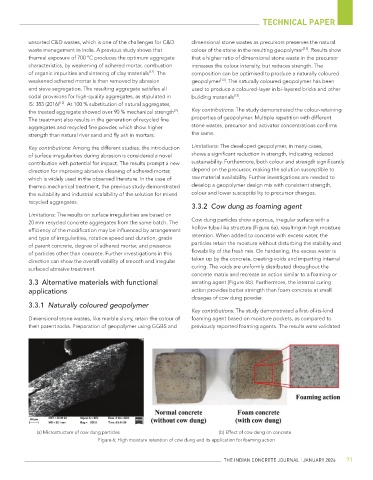
           20 mm recycled concrete aggregates from the same batch. The   Cow dung particles show a porous, irregular surface with a
           efficiency of the modification may be influenced by arrangement   hollow tube-like structure (Figure 6a), resulting in high moisture
           and type of irregularities, rotation speed and duration, grade   retention. When added to concrete with excess water, the
           of parent concrete, degree of adhered mortar, and presence   particles retain the moisture without disturbing the stability and
           of particles other than concrete. Further investigations in this   flowability of the fresh mix. On hardening, the excess water is
           direction can show the overall viability of smooth and irregular   taken up by the concrete, creating voids and imparting internal
           surfaced abrasive treatment.                           curing. The voids are uniformly distributed throughout the
                                                                  concrete matrix and recreate an action similar to a foaming or
           3.3  Alternative materials with functional             aerating agent (Figure 6b). Furthermore, the internal curing
           applications                                           action provides better strength than foam concrete at small
                                                                  dosages of cow dung powder.
           3.3.1  Naturally coloured geopolymer
                                                                  Key contributions: The study demonstrated a first-of-its-kind
           Dimensional stone wastes, like marble slurry, retain the colour of   foaming agent based on moisture pockets, as compared to
           their parent rocks. Preparation of geopolymer using GGBS and   previously reported foaming agents. The results were validated


              (a) Microstructure of cow dung particles                     (b) Effect of cow dung on concrete
                                  Figure 6: High moisture retention of cow dung and its application for foaming action


                                                                            THE INDIAN CONCRETE JOURNAL | JANUARY 2026  71

