


Page 13 - ICJ Jan 2026
P. 13
TECHNICAL PAPER


           4.2  Alternative rheological models and testing        distinct shear rate protocol, which can be applied to study the
                                                                  rheological behaviour of cement paste in a fully broken-down
           methodology
                                                                  state. The protocol removes reversible structuration and studies
           A new test protocol has been designed to understand the   the irreversible changes. The study presents the basis towards
           irreversible changes by bringing the cement paste to a fully   a better understanding of cement rheology by separately
                                                       [31]
           broken-down state, termed ‘distinct shear rate protocol . In   accounting for reversible and irreversible changes.
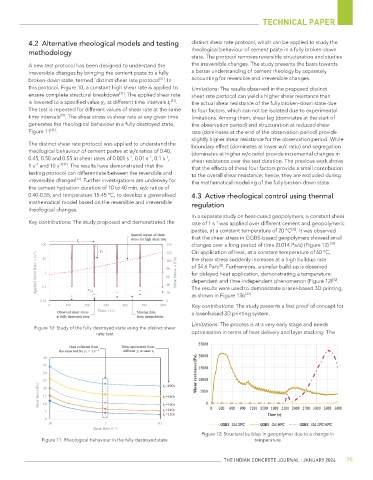
           this protocol, Figure 10, a constant high shear rate is applied to   Limitations: The results observed in the proposed distinct
                                         [31]
           ensure complete structural breakdown . The applied shear rate   shear rate protocol can yield a higher shear resistance than
                                                           [31]
           is lowered to a specified value γ i , at different time intervals t j  .   the actual shear resistance of the fully broken-down state due
           The test is repeated for different values of shear rate at the same   to four factors, which can not be isolated due to experimental
           time intervals . The shear stress vs shear rate at any given time   limitations. Among them, shear lag (dominates at the start of
                     [31]
           generates the rheological behaviour in a fully destroyed state,   the observation period) and structuration at reduced shear
                  [31]
           Figure 11 .                                            rate (dominates at the end of the observation period) provide
                                                                  slightly higher shear resistance for the observation period. While
           The distinct shear rate protocol was applied to understand the   boundary effect (dominates at lower w/c ratio) and segregation
           rheological behaviour of cement pastes at w/c ratios of 0.40,   (dominates at higher w/c ratio) provide incremental changes in
                                                         –1
                                                   –1
                                            –1
           0.45, 0.50 and 0.55 at shear rates of 0.001 s , 0.01 s , 0.1 s ,   shear resistance over the test duration. The previous work shows
             –1
           1 s  and 10 s –1[31] . The results have demonstrated that the   that the effects of these four factors provide a small contribution
           testing protocol can differentiate between the reversible and   to the overall shear resistance; hence, they are excluded during
                           [31]
           irreversible changes . Further investigations are underway for   the mathematical modeling of the fully broken-down state.
           the cement hydration duration of 10 to 40 min, w/c ratios of
           0.40-0.55, and temperature 15-45 °C, to develop a generalised   4.3  Active rheological control using thermal
           mathematical model based on the reversible and irreversible   regulation
           rheological changes.
                                                                  In a separate study on heat-cured geopolymers, a constant shear
           Key contributions: The study proposed and demonstrated the   rate of 1 s  was applied over different cement and geopolymeric
                                                                         –1
                                                                  pastes, at a constant temperature of 20 °C . It was observed
                                                                                                   [32]
                                                                  that the shear stress in GGBS-based geopolymers showed small
                                                                                                                [32]
                                                                  changes over a long period of time (0.014 Pa/s) (Figure 12)  .
                                                                  On application of heat, at a constant temperature of 60 °C,
                                                                  the shear stress suddenly increases at a high buildup rate
                                                                           32]
                                                                  of 54.6 Pa/s . Furthermore, a similar build-up is observed
                                                                  for delayed heat application, demonstrating a temperature-
                                                                                                                 [32]
                                                                  dependent and time-independent phenomenon (Figure 12) .
                                                                  The results were used to demonstrate a laser-based 3D printing,
                                                                                    [32]
                                                                  as shown in Figure 13b .
                                                                  Key contributions: The study presents a first proof of concept for
                                                                  a laser-based 3D printing system.

                                                                  Limitations: The process is at a very early stage and needs
             Figure 10: Study of the fully destroyed state using the distinct shear
                                 rate test                        optimisation in terms of heat delivery and layer stacking. The


                                                                     Figure 12: Structural buildup in geopolymer due to a change in
               Figure 11: Rheological behaviour in the fully destroyed state           temperature


                                                                            THE INDIAN CONCRETE JOURNAL | JANUARY 2026  75

