


Page 16 - ICJ Jan 2026
P. 16
TECHNICAL PAPER


           Functionally graded pavements: Functionally graded concrete   compressive strength loss as compared to freeze-thaw, followed
                                                                               [36]
           has been extensively investigated to improve the flexural   by fatigue cycles . Furthermore, early exposure to freeze-thaw,
           performance of concrete. In a study on the functionally graded   the concrete showed higher residual compressive strength
                                                                                             [36]
           cubes, it was observed that the overall strength is higher than   but lower flexural fatigue strength . The results indicate that
                                          [35]
           the strength of the weaker bottom layer . Further investigation   freeze-thaw before fatigue is more detrimental to flexural
           confirmed that the increased strength can be attributed to the   strength under fatigue, while fatigue before freeze-thaw is more
                                                                                              [36]
                                       [35]
           stress distribution at the upper layer . The results suggest that   detrimental to compressive strength .
           functionally graded pavements can be prepared with a slightly   Key contributions: Through the specific scenario of fatigue and
           weaker bottom layer for better economy.                freeze-thaw, the study demonstrates the coupled effect of the
                                                                  exposure scenario.
           Key contributions: The various studies, at a meta-heuristic level,
           provide better techniques for the field application of concrete.   Limitations: This work needs to be replicated over various
           At a fundamental level, the studies explore different variations   scenarios to establish the exact mechanism of the coupled effect
           in the mixing and casting procedures and observe their effect   and translate it to safety guidelines. Similar studies are also
           on the properties of concrete. A better understanding of the   needed to understand the interplay between various exposure
           effects can help in improving the mixing and casting procedure   scenarios.
           of concrete.
                                                                  6.2 Fire safety guidelines for limestone calcined
           Limitations: The replicability of the results significantly depends   clay cement
           on the type of mix and instrument used. Therefore, the results                     3
           present a direction to the stakeholders towards possible mixing   Limestone calcined clay cement (LC ) is a new type of
           and casting strategies for various concrete applications.   ternary blended cement, and is considered an eco-friendlier
                                                                  alternative to ordinary Portland cement (OPC) and Portland
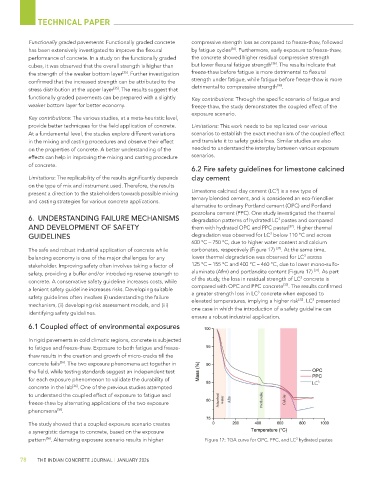
                                                                  pozzolana cement (PPC). One study investigated the thermal
           6.  UNDERSTANDING FAILURE MECHANISMS                   degradation patterns of hydrated LC  pastes and compared
                                                                                               3
                                                                                                  [37]
           AND DEVELOPMENT OF SAFETY                              them with hydrated OPC and PPC pastes . Higher thermal
                                                                                            3
           GUIDELINES                                             degradation was observed for LC  below 110 °C and across
                                                                  600 °C – 750 °C, due to higher water content and calcium

                                                                                              [37]
           The safe and robust industrial application of concrete while   carbonates, respectively (Figure 17)  . At the same time,
                                                                                                        3
           balancing economy is one of the major challenges for any   lower thermal degradation was observed for LC  across
           stakeholder. Improving safety often involves taking a factor of   125 °C – 155 °C and 400 °C – 460 °C, due to lower mono-sulfo-


                                                                                                           [37]
           safety, providing a buffer and/or introducing reserve strength to   aluminate (Afm) and portlandite content (Figure 17)  . As part
                                                                                                      3
           concrete. A conservative safety guideline increases costs, while   of the study, the loss in residual strength of LC  concrete is
                                                                                                 [32]
           a lenient safety guideline increases risks. Developing suitable   compared with OPC and PPC concrete . The results confirmed
                                                                                        3
           safety guidelines often involves (i) understanding the failure   a greater strength loss in LC  concrete when exposed to
                                                                                                          3
                                                                                                      [32]
                                                                  elevated temperatures, implying a higher risk . LC  presented
           mechanism, (ii) developing risk assessment models, and (iii)   one case in which the introduction of a safety guideline can
           identifying safety guidelines.
                                                                  ensure a robust industrial application.
           6.1 Coupled effect of environmental exposures
           In rigid pavements in cold climatic regions, concrete is subjected
           to fatigue and freeze-thaw. Exposure to both fatigue and freeze-
           thaw results in the creation and growth of micro-cracks till the
                     [36]
           concrete fails . The two exposure phenomena act together in
           the field, while testing standards suggest an independent test
           for each exposure phenomenon to validate the durability of
                                                                                                          LC 3
           concrete in the lab . One of the previous studies attempted
                          [36]
           to understand the coupled effect of exposure to fatigue and
           freeze-thaw by alternating applications of the two exposure
           phenomena .
                    [36]
           The study showed that a coupled exposure scenario creates
           a synergistic damage to concrete, based on the exposure
                [36]
           pattern . Alternating exposure scenario results in higher   Figure 17: TGA curve for OPC, PPC, and LC  hydrated pastes
                                                                                                     3
        78    THE INDIAN CONCRETE JOURNAL | JANUARY 2026

