


Page 17 - ICJ Jan 2026
P. 17
TECHNICAL PAPER


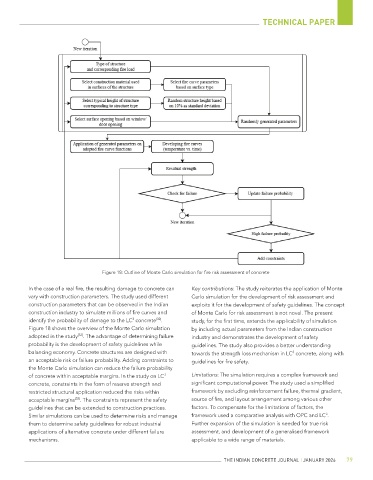
                                   Figure 18: Outline of Monte Carlo simulation for fire risk assessment of concrete

           In the case of a real fire, the resulting damage to concrete can   Key contributions: The study reiterates the application of Monte
           vary with construction parameters. The study used different   Carlo simulation for the development of risk assessment and
           construction parameters that can be observed in the Indian   exploits it for the development of safety guidelines. The concept
           construction industry to simulate millions of fire curves and   of Monte Carlo for risk assessment is not novel. The present
                                                      [32]
           identify the probability of damage to the LC  concrete .   study, for the first time, extends the applicability of simulation
                                              3
           Figure 18 shows the overview of the Monte Carlo simulation   by including actual parameters from the Indian construction
                           [32]
           adopted in the study . The advantage of determining failure   industry and demonstrates the development of safety
           probability is the development of safety guidelines while   guidelines. The study also provides a better understanding
           balancing economy. Concrete structures are designed with   towards the strength loss mechanism in LC  concrete, along with
                                                                                                    3
           an acceptable risk or failure probability. Adding constraints to   guidelines for fire safety.
           the Monte Carlo simulation can reduce the failure probability
           of concrete within acceptable margins. In the study on LC    Limitations: The simulation requires a complex framework and
                                                        3
           concrete, constraints in the form of reserve strength and   significant computational power. The study used a simplified
           restricted structural application reduced the risks within   framework by excluding reinforcement failure, thermal gradient,
           acceptable margins . The constraints represent the safety   source of fire, and layout arrangement among various other
                          [32]
           guidelines that can be extended to construction practices.   factors. To compensate for the limitations of factors, the
                                                                                                               3
           Similar simulations can be used to determine risks and manage   framework used a comparative analysis with OPC and LC .
           them to determine safety guidelines for robust industrial   Further expansion of the simulation is needed for true risk
           applications of alternative concrete under different failure   assessment, and development of a generalised framework
           mechanisms.                                            applicable to a wide range of materials.


                                                                            THE INDIAN CONCRETE JOURNAL | JANUARY 2026  79

