


Page 15 - ICJ Jan 2026
P. 15
TECHNICAL PAPER


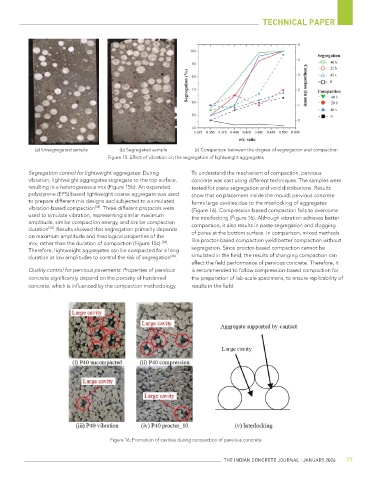
             (a) Unsegregated sample     (b) Segregated sample     (c) Comparison between the degree of segregation and compaction
                                     Figure 15: Effect of vibration on the segregation of lightweight aggregates


           Segregation control for lightweight aggregates: During   To understand the mechanism of compaction, pervious
           vibration, lightweight aggregates segregate to the top surface,   concrete was cast using different techniques. The samples were
           resulting in a heterogeneous mix (Figure 15b). An expanded   tested for paste segregation and void distributions. Results
           polystyrene (EPS) based lightweight coarse aggregate was used   show that on placement inside the mould, pervious concrete
           to prepare different mix designs and subjected to a simulated   forms large cavities due to the interlocking of aggregates
           vibration-based compaction . Three different protocols were   (Figure 16). Compression-based compaction fails to overcome
                                 [34]
           used to simulate vibration, representing similar maximum   the interlocking (Figure 16). Although vibration achieves better
           amplitude, similar compaction energy, and similar compaction   compaction, it also results in paste segregation and clogging
           duration . Results showed that segregation primarily depends   of pores at the bottom surface. In comparison, mixed methods
                 [34]
           on maximum amplitude and rheological properties of the   like proctor-based compaction yield better compaction without
                                                        [34]
           mix, rather than the duration of compaction (Figure 15c)  .
           Therefore, lightweight aggregates can be compacted for a long   segregation. Since proctor-based compaction cannot be
           duration at low amplitudes to control the risk of segregation .  simulated in the field, the results of changing compaction can
                                                           [34]
                                                                  affect the field performance of pervious concrete. Therefore, it
           Quality control for pervious pavements: Properties of pervious   is recommended to follow compression-based compaction for
           concrete significantly depend on the porosity of hardened   the preparation of lab-scale specimens, to ensure replicability of
           concrete, which is influenced by the compaction methodology.   results in the field.


                                      Figure 16: Formation of cavities during compaction of pervious concrete


                                                                            THE INDIAN CONCRETE JOURNAL | JANUARY 2026  77

