


Page 7 - ICJ Jan 2026
P. 7
TECHNICAL PAPER


           and landed cost of SCM used in trial i, cost of test j, number of   3.  INSIGHTS ON NEW MATERIALS AND
           trials, number of tests, and data set k based on previous trials,   ALTERNATIVE APPLICATIONS
           respectively.
                                                                  3.1  Food waste as nutrient media for
           Key contribution: The mathematical equation demonstrates the   bio-cementation
           principles of macroeconomics in civil engineering applications
                                                                  Food waste and cement manufacturing are two major
           by introducing probability functions. The approach presents   contributors to global carbon emissions . Literature shows that
                                                                                                 [9]
           a novel framework that, when fully evolved, can quantify the   sequestering CO 2  in concrete can lower the carbon footprint
                                                                                                 [9]
           amount one can spend on research while ensuring profit. This   and improve the properties of concrete . The conventional
           will effectively encourage stakeholders to explore alternative   strategies for carbon sequestration focus on captured CO 2 .
                                                                  In a previous study, CO 2  released through the controlled
           materials based on a quantified matrix.
                                                                  decomposition of food waste was explored as an alternate route
                                                                                                [9]
                                                                  for carbon sequestration in concrete . Here, food waste, along
           Limitation: The mathematical equation was validated over a
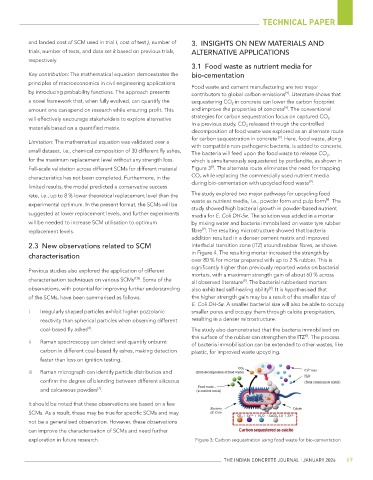
                                                                  with compatible non-pathogenic bacteria, is added to concrete.
           small dataset, i.e., chemical composition of 30 different fly ashes,   The bacteria will feed upon the food waste to release CO 2 ,
           for the maximum replacement level without any strength loss.   which is simultaneously sequestered by portlandite, as shown in
                                                                        [9]
           Full-scale validation across different SCMs for different material   Figure 3 . The alternate route eliminates the need for trapping
           characteristics has not been completed. Furthermore, in the   CO 2  while replacing the commercially used nutrient media
                                                                                                         [9]
                                                                  during bio-cementation with upcycled food waste .
           limited results, the model predicted a conservative success
           rate, i.e., up to 8 % lower theoretical replacement level than the   The study explored two major pathways for upcycling food
                                                                  waste as nutrient media, i.e., powder form and pulp form . The
                                                                                                               [9]
           experimental optimum. In the present format, the SCMs will be
                                                                  study showed high bacterial growth in powder-based nutrient
           suggested at lower replacement levels, and further experiments   media for E. Coli DH-5α. The solution was added in a mortar
           will be needed to increase SCM utilisation to optimum   by mixing water and bacteria immobilised on waste tyre rubber
                                                                     [9]
           replacement levels.                                    fibre . The resulting microstructure showed that bacteria
                                                                  addition resulted in a denser cement matrix and improved
           2.3  New observations related to SCM                   interfacial transition zone (ITZ) around rubber fibres, as shown
                                                                  in Figure 4. The resulting mortar increased the strength by
           characterisation
                                                                  over 80 % for mortar prepared with up to 2 % rubber. This is
                                                                  significantly higher than previously reported works on bacterial
           Previous studies also explored the application of different
                                                                  mortars, with a maximum strength gain of about 60 % across
           characterisation techniques on various SCMs [7,8] . Some of the   all observed literature . The bacterial rubberised mortars
                                                                                   [9]
           observations, with potential for improving further understanding   also exhibited self-healing ability . It is hypothesised that
                                                                                            [9]
           of the SCMs, have been summarised as follows:          the higher strength gain may be a result of the smaller size of
                                                                  E. Coli DH-5α. A smaller bacterial size will also be able to occupy
           i   Irregularly shaped particles exhibit higher pozzolanic   smaller pores and occupy them through calcite precipitation,
               reactivity than spherical particles when observing different   resulting in a denser microstructure.
                               [8]
               coal-based fly ashes .                             The study also demonstrated that the bacteria immobilised on
                                                                                                        [9]
                                                                  the surface of the rubber can strengthen the ITZ . The process
           ii   Raman spectroscopy can detect and quantify unburnt
                                                                  of bacteria immobilisation can be extended to other wastes, like
               carbon in different coal-based fly ashes, making detection   plastic, for improved waste upcycling.
               faster than loss on ignition testing .
           iii   Raman micrograph can identify particle distribution and
               confirm the degree of blending between different siliceous
                                  [7]
               and calcareous powders .
           It should be noted that these observations are based on a few
           SCMs. As a result, these may be true for specific SCMs and may
           not be a generalised observation. However, these observations
           can improve the characterisation of SCMs and need further
           exploration in future research.                         Figure 3: Carbon sequestration using food waste for bio-cementation


                                                                            THE INDIAN CONCRETE JOURNAL | JANUARY 2026  69

