


Page 6 - ICJ Jan 2026
P. 6
TECHNICAL PAPER


           Group  Category    Identifying composition             Relevant IS code  SCM
           I     Silicate     Si ≥ 85                             IS: 15388 (2003) [3]  Rice husk ash, Silica fume, Micronized biomass silica,
           II    Alumina silicate  (Si+Al+Fe) ≥ 70, Si ≥ 35       IS:  3812-2  (2013) Calcined clay, Ceramic waste, Glass powder, Fly ash,
                                                                  [4]          Metakaolin, Bagasse ash,
           III   Calcareous   (Si+Al+Fe) ≥ 50, Ca ≥ 10, Si ≥ 25   IS: 3812-2 (2013)  Sewage sludge ash, Cupola slag
                 alumina silicate                                 [4]
           IV    Slag         CaO+MgO+Al 2 O 3  ≥ SiO 2,  CaO+MgO+1/3.Al 2 O 3  IS: 12089 (1987) [5]  BOF slag, GGBS, Jarrosite slurry, EAF
                              ≥ SiO 2 +2/3.Al 2 O 3
           V     Calcites     MgO+CaO+LoI ≥ 50, CaO ≥ 30          -            Marble powder, Lime sludge, Wollastonite
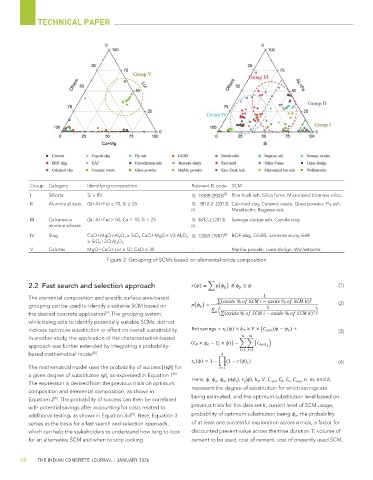
                                     Figure 2: Grouping of SCMs based on elemental oxide composition


           2.2  Fast search and selection approach                                                                 (1)
           The elemental composition and specific surface area-based
           grouping can be used to identify a suitable SCM based on                                                (2)
                                    [1]
           the desired concrete application . The grouping system,
           while being able to identify potentially suitable SCMs, did not
           indicate optimum substitution or effect on overall sustainability.                                      (3)
           In another study, the application of the characterisation-based
           approach was further extended by integrating a probability-
                                [6]
           based mathematical model .
                                                                                                                   (4)
           The mathematical model uses the probability of success [r(ϕ)] for
           a given degree of substitution (ϕ), as expressed in Equation 1 .
                                                           [6]
           The expression is derived from the previous trials on optimum   Here, ϕ, ϕ p , ϕ 0 , p(ϕ p ), r n (ϕ), k T , V, C cem , C 0 , C i , C test j , n, m, and k,
           composition and elemental composition, as shown in     represent the degree of substitution for which savings are
                   [6]
           Equation 2 . The probability of success can then be correlated   being estimated, and the optimum substitution level based on
           with potential savings after accounting for costs related to   previous trials for the data set k, current level of SCM usage,
                                             [6]
           additional testing, as shown in Equation 3-4 . Here, Equation 3   probability of optimum substitution being ϕ p , the probability
           serves as the basis for a fast search and selection approach,   of at least one successful exploration across n trials, a factor for
           which can help the stakeholders to understand how long to look   discounted present value across the time duration T, volume of
           for an alternative SCM and when to stop looking.       cement to be used, cost of cement, cost of presently used SCM,


        68    THE INDIAN CONCRETE JOURNAL | JANUARY 2026

