


Page 5 - ICJ Feb Openaccess 2026
P. 5
TECHNICAL PAPER


           Table 1: Chemical composition of flyash (%)

                                                         CaO        K 2 O     MgO                             Na 2 O
               SiO 2     Al 2 O 3  Fe 2 O 3   TiO 2                                      P 2 O 5    SO 3
              63.20      26.19      3.82      1.68       1.30       1.10      0.67       0.40       0.23      0.20


           The surface area of fly ash as per IS: 3812 Part-1 (2013) by Blains   2.2  Mix details
                                2
           air permeability was 342 m /kg . The chemical composition
                                   [7]
           of fly ash is specified in Table 1. For alkaline activator, sodium   Four different mixes for different strength have been prepared
           based silicates and hydroxides have been used. The percentage   in GPCT. Same mix proportions have been used for GPCA.
           rage of ingredients of liquid sodium silicates has been decided   For doing comparison of strength, the cement concrete mixes
           from the literature review. Also the molarity of sodium hydroxide   having similar compressive strength to GPCT have been
           was decided based on the strength of concrete by conducting   prepared. The quantities of fly ash used for the production of
           the preliminary trials with 8, 10, 12, 14, and 16 molar. The liquid   four mixes of GPCT are 300, 380, 460, and 540 kg/cu.m. The
                                                                  same quantities of fly ash have been used for the GPCA mixes,
           form sodium silicates (SS) having Na 2 O-14.37 %, SiO 2 -33.10
                                                                  only 4 % of the fly ash replaced by OPC. To enhance strength
           % and Water 52.53 % has been used with 14 molar sodium
                                                                  at ambient temperature, OPC is added to the GPCA mixes
           hydroxide (SH) solution to prepare alkaline activator solution.
           The total solid content in 14 molar NaOH solution was 40.73 %.   as a curing agent. Based on the laboratory trials, the alkaline
                                                                  solution to fly ash ratio and SS to SH ratio has been taken as 0.4
           In fine aggregates, the combination of river sand (45 %) and
                                                                                [10]
                                                                  and 2 respectively . Also, based on the trials conducted in the
                                         [8]
           treated sea sand (55 %) has been used . The sea sand has been
                                                                  laboratory, the total quantity of water for unit volume of concrete
           washed by tap water to remove the salt, chlorides and other                          [8]
           impurities present in the sea sand. After this treatment it named   has been decided to take as 110 litres . The percentage of fine
                                                                  aggregates in the mix was 35 % of the total aggregate content.
           as treated sea sand. Various trials has been carried out to get
                                                                  Considering the quantity of water available in the sodium
           well graded fine aggregates. The combination of 45 % river
                                                                  silicate and sodium hydroxide, the additional water has been
           sand and 55 % treated sea sand becomes a well graded fine   used to fulfil the total quantity of water required for one cubic
           aggregates. For coarse aggregates, 20 and 10 mm black basalt
                                                                  metre volume of concrete. For maintaining the workability of all
           crushed angular aggregates has been used. Fine aggregates
                                                                  mixes of GPC as similar to the mixes of cement concrete, the
           and coarse aggregates have been conforming to IS: 383 (2016)
                                                                  Plastiment 100 of Sika India has been used as a super-plasticizer.
           [9] . The properties of aggregates are presented in Table 2 and   Proceed with these parameters, the quantities of ingredients of
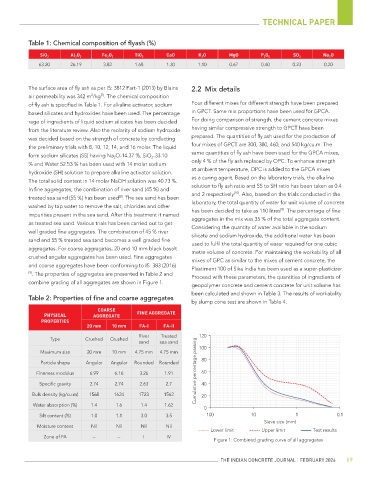
           combine grading of all aggregates are shown in Figure 1.
                                                                  geopolymer concrete and cement concrete for unit volume has
                                                                  been calculated and shown in Table 3. The results of workability
           Table 2: Properties of fine and coarse aggregates
                                                                  by slump cone test are shown in Table 4.
                                  COARSE
                PHYSICAL        AGGREGATE      FINE AGGREGATE
               PROPERTIES
                              20 mm    10 mm    FA-I    FA-II
                                                River   Treated     120
                  Type        Crushed  Crushed
                                                sand   sea sand
               Maximum size   20 mm    10 mm   4.75 mm  4.75 mm     100
               Particle shape  Angular  Angular  Rounded  Rounded    80
             Fineness modulus  6.99     6.16    3.26     1.91      Cumulative percentage passing  60
              Specific gravity  2.74    2.74    2.63     2.7         40
            Bulk density (kg/cu.m)  1568   1624   1723  1562         20

            Water absorption (%)  1.4   1.6      1.4    1.62
                                                                      0
              Silt content (%)  1.0     1.1      3.0     3.5           100            10             1             0.1
                                                                                          Sieve size (mm)
              Moisture content  Nil     Nil      Nil     Nil
                                                                        Lower limit      Upper limit      Test results
                Zone of FA      --       --      I       IV
                                                                         Figure 1: Combined grading curve of all aggregates


                                                                           THE INDIAN CONCRETE JOURNAL | FEBRUARY 2026  69

